


Important information: Mortgage Bridge provides general information and administrative support as a mortgage introducer. It does not provide mortgage or debt advice, assess eligibility, affordability or suitability, or recommend products. Mortgage advice comes from an adviser acting through an FCA-authorised and regulated network.
Your home may be repossessed if you do not keep up repayments on your mortgage.
Financial associations are links recorded by credit reference agencies between people with certain shared financial arrangements. A mortgage lender may consider information about a financial associate as part of its assessment.
This does not merge your credit reports or automatically make you responsible for the other person’s separate debts. The effect on a mortgage application depends on the financial connection, relevant account information, your circumstances and the lender’s current criteria.
What can create financial associations?
A financial association can arise through arrangements or events such as:
- Opening a joint current account.
- Applying jointly for credit, such as a loan or mortgage.
- A joint County Court Judgment.
A recorded association does not necessarily mean that a joint account is currently open. A joint application can create a link, and an association may remain recorded after a financial arrangement has ended.
If you are unsure why someone appears as an associate, the relevant credit reference agency can explain the recorded connection and its process for investigating inaccuracies.
Does Sharing an Address Create a Link?
Sharing an address, being related, marrying or entering a civil partnership does not, by itself, create a financial association on a credit report.
A previous resident’s credit history does not become yours simply because you live at the same property. Receiving correspondence addressed to someone else also does not itself establish a shared financial arrangement.
Address history and financial associations are different types of information. A lender may need address details to identify you without that creating a connection to everyone who has lived there.
What About an Additional Credit Cardholder?
Being an additional cardholder is different from jointly taking out a loan or mortgage. It should not automatically be described as a joint credit agreement or evidence of shared liability.
The account terms establish who is responsible for payments. If you are uncertain about an account or recorded association, obtain clarification from the provider or credit reference agency.
Do Your Credit Reports Become Combined?
No. Each person retains their own credit report. A financial association records a connection that may allow a lender to consider relevant information about the associated person.
The other person’s separate defaults or judgments do not become entries against you merely because you are associated. However, the lender may consider their credit information when assessing your application.
Where an adverse entry concerns a joint account or joint obligation, it may also be relevant to your own account history. That is different from an associate’s separate borrowing.
Does an Association Make You Responsible for Their Debts?
A credit report association does not itself create responsibility for another person’s separate debts. Liability depends on the agreement and the capacity in which you entered it.
For joint borrowing, the agreement may make each borrower responsible for the full outstanding amount rather than an assumed half share. A guarantee can also create obligations under its terms.
If you are unsure about responsibility for a debt, appropriate debt or legal advice may be needed. Removing a credit report association does not cancel an agreement or release a borrower or guarantor.
What May a Mortgage Lender Consider?
Depending on its criteria and the application, a lender may consider:
- The nature of the financial association.
- Whether shared accounts or commitments remain active.
- Your own payment history and outstanding borrowing.
- Relevant information about the financial associate.
- Whether the mortgage application is sole or joint.
- Income, household expenditure and other financial responsibilities.
- The proposed mortgage, property and deposit funds.
There is no universal rule stating that an associate’s adverse credit will cause a decline or can be offset by your own credit history. A lender assesses the information under its current requirements.
Sole and Joint Mortgage Applications
On a joint mortgage application, the lender assesses the applicants and relevant commitments under its criteria. One applicant’s stronger credit history does not automatically compensate for another applicant’s payment difficulties.
Applying in one name does not necessarily prevent consideration of a recorded financial association. Household costs, existing joint commitments and the proposed ownership or occupancy arrangements may also remain relevant.
The structure of an application can have financial and legal implications. This guide does not recommend applying alone, removing an applicant or changing ownership arrangements to pursue a mortgage.
What Happens After a Relationship Ends?
Separation, divorce or moving out does not automatically end joint borrowing or remove a recorded financial association.
A joint account may remain open, and obligations under a mortgage, loan or guarantee may continue. A private agreement between people about who will make payments does not necessarily change their obligations to the provider.
The account provider can explain what is required to change an agreement. Where property, separation or liability is involved, independent legal advice may also be appropriate.
What Is Financial Disassociation?
Financial disassociation is the process of asking a credit reference agency to remove a financial link that no longer applies or is inaccurate.
If the financial connection has ended, you can contact the relevant agencies to ask about their requirements. They may request information about the former arrangement and evidence of its current status.
Closing a joint account does not necessarily remove the association automatically. Equally, a request for disassociation is not confirmation that the link has been removed.
The agency determines whether its requirements are met. Do not assume that a particular rule or exception applies without checking the relevant agency’s process.
Need help with your mortgage?
What happens after a mortgage enquiry?
This is an initial enquiry for administrative support and an adviser introduction where appropriate. It is not a mortgage application or an eligibility assessment. Any mortgage advice comes separately from an adviser acting through an FCA-authorised and regulated network. The receiving firm explains its service, fees and information requirements.
Mortgage Bridge has commercial relationships with receiving firms and receives a percentage of the adviser’s commission when an introduced case completes. Acceptance is not guaranteed.
Ask about an adviser introduction
Send details of your enquiry for administrative support and an adviser introduction where appropriate. Mortgage Bridge does not provide mortgage or debt advice, assess eligibility, affordability or suitability, or recommend products. Mortgage advice comes from an adviser acting through an FCA-authorised and regulated network.
Make a mortgage enquiryNo obligation. Mortgage Bridge acts as a mortgage introducer.
Mortgage Bridge has commercial relationships with receiving firms and receives a percentage of the adviser’s commission when an introduced case completes.
Your home may be repossessed if you do not keep up repayments on your mortgage.
Does Disassociation Erase Previous Joint Account History?
Removing a financial association is different from correcting or deleting account information. It does not automatically remove accurate payment history relating to an account for which you were responsible.
It also does not end a current commitment, change ownership of property or release you from a guarantee. Those matters require separate consideration.
A confirmed disassociation does not guarantee a mortgage offer. The lender still assesses your circumstances, relevant commitments and application information.
Checking a Recorded Association
You can check the financial associations recorded in your own credit reports. Information may differ between credit reference agencies, so a change shown on one report should not automatically be assumed to appear on another.
If a link is unfamiliar or appears inaccurate, raise it with the relevant agency. It can explain its investigation process and what evidence it needs.
Do not access another person’s private credit report without appropriate authority. An adviser or lender can explain what information is required and how it should be supplied securely.
Does the Age of the Association Matter?
The date a connection was created does not, by itself, establish whether it remains accurate or relevant. An old association may still relate to an active commitment.
Reporting periods for account information and adverse entries are separate from the question of whether a financial association should remain recorded. There is no universal six-year rule under which every association automatically ends.
There is also no fixed waiting period after disassociation that guarantees mortgage acceptance.
Does a Larger Deposit or Specialist Lender Resolve the Issue?
A deposit affects the proportion of the property’s value being borrowed, known as the loan-to-value ratio. It does not remove joint obligations or replace credit and affordability assessments.
No deposit percentage guarantees acceptance. It should also not be assumed that a specialist lender will disregard a financial association or accept an application that fails its affordability requirements.
An adviser acting through an FCA-authorised and regulated network can assess potential options within the scope of their firm’s service. Any application remains subject to the lender’s decision.
What Information May Be Requested?
An adviser or lender may request:
- Credit reports showing the recorded association and relevant accounts.
- Statements confirming shared balances and repayment commitments.
- Confirmation that a joint account has closed or an agreement has changed.
- Correspondence confirming the outcome of a disassociation request.
- Evidence of income, household expenditure and other commitments.
- Evidence of deposit funds and their source.
Requirements and document periods vary. Providing evidence helps explain the circumstances but does not guarantee mortgage acceptance.
If you are unsure about joint debt or are struggling with repayments, free debt advice can help explain your options. Services can be found through MoneyHelper’s debt advice locator.
Mortgage Bridge does not advise on closing joint accounts, transferring debts, ending guarantees or changing legal ownership arrangements.
How Mortgage Bridge Can Help
Mortgage Bridge provides general information and administrative support and passes mortgage enquiries to advisers acting through an FCA-authorised and regulated network. We do not recommend mortgages, assess suitability or confirm whether a lender will accept an application.
An adviser receiving your enquiry can discuss your circumstances and explain the services their firm provides, including any applicable fees. Any mortgage application remains subject to the lender’s assessment and current criteria.
Mortgage Bridge has commercial relationships with receiving firms. When an introduced case completes, we receive a percentage of the commission earned by the adviser. We therefore have a financial interest in completed introductions.
Further information about our role and how enquiries are handled is available in our About Us page, Terms and Conditions and Privacy Policy.
This guide provides general information only. It is not mortgage, debt or legal advice. Lender criteria and individual circumstances vary, and no mortgage outcome is guaranteed.
Your home may be repossessed if you do not keep up repayments on your mortgage.
Eligibility, affordability and suitability
Visual explanation: eligibility, affordability and suitability
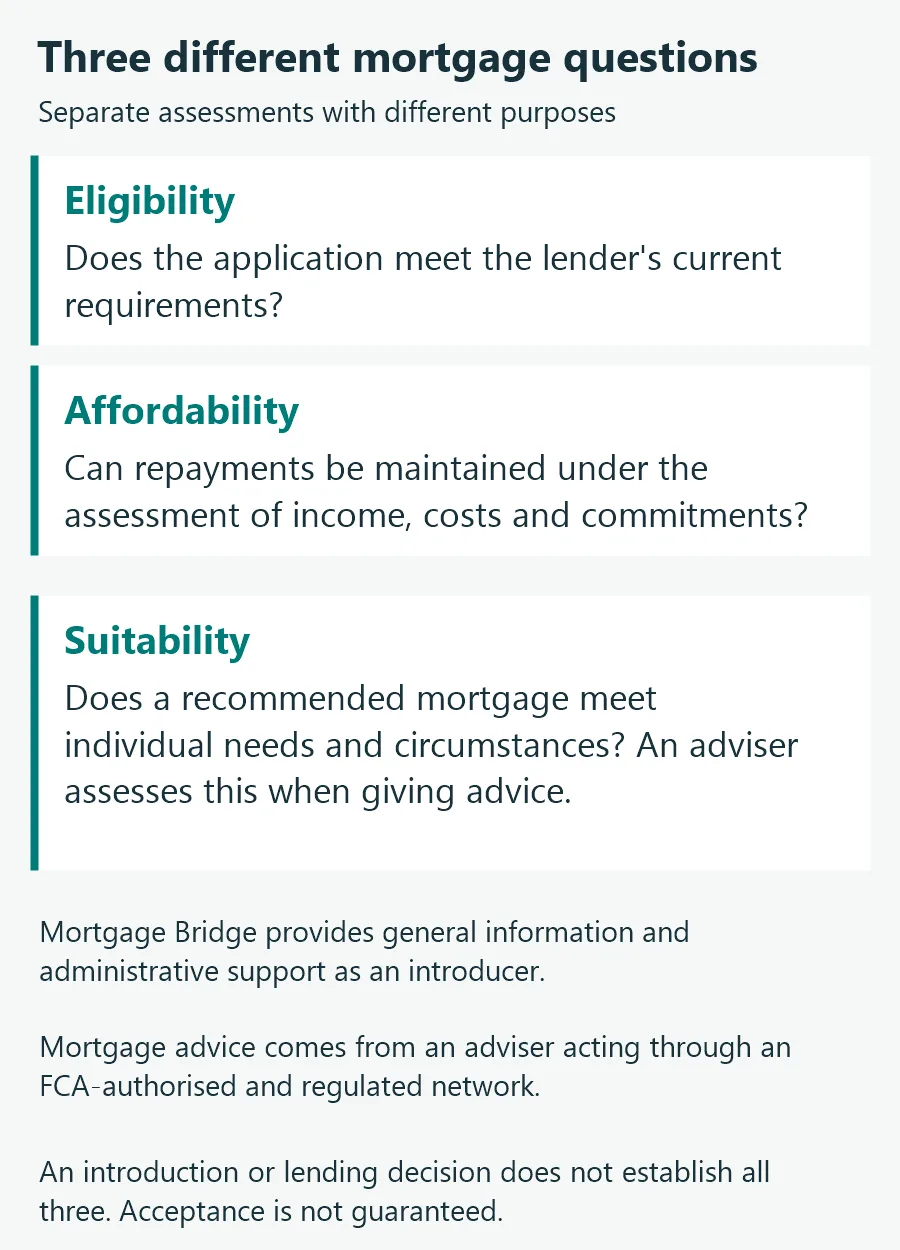
Eligibility concerns a lender’s current requirements. Affordability concerns whether repayments can be maintained, taking account of relevant income, expenditure and commitments. Suitability concerns whether a recommended mortgage meets individual needs and circumstances and is assessed when an adviser acting through an FCA-authorised and regulated network provides mortgage advice. Meeting one assessment does not establish the others. Mortgage Bridge does not carry out these assessments.
Costs and independent debt support
Free, independent debt advice is available through MoneyHelper’s debt advice locator. This guide does not recommend changing debt repayments, using savings or taking additional credit to obtain a mortgage.
Securing previously unsecured debts against a home increases the risk to the home. Lower monthly payments do not necessarily mean lower total costs. Longer repayment terms and fees can increase the total amount repaid.
Referral disclosure
Mortgage Bridge has commercial relationships with receiving firms and receives a percentage of the adviser’s commission when an introduced case completes. An introduction does not guarantee acceptance or completion.
Read about us, our terms and conditions and our privacy policy.
Frequently asked questions
Does meeting one criterion guarantee a mortgage offer?
No. The lender assesses the complete application, including credit, affordability, property and other requirements. Acceptance is not guaranteed.
Does Mortgage Bridge assess eligibility or recommend a mortgage?
No. Mortgage Bridge provides general information and administrative support as a mortgage introducer. It does not assess eligibility, affordability or suitability or provide mortgage or debt advice. Mortgage advice comes from an adviser acting through an FCA-authorised and regulated network.
Sources and review
- FCA Handbook: responsible lending
- FCA Handbook: mortgage advice and suitability
- TransUnion: account information and reporting
- ICO: credit records and accuracy
- MoneyHelper: consolidation risks
- MoneyHelper: shared financial responsibilities
Last reviewed: . This article is subject to periodic review. Information and lender criteria may change. General information only; this is not a personal recommendation.
Check your credit in detail
View your full credit report
See your credit information from all three major credit reference agencies with Checkmyfile. Try it free, then it becomes a paid monthly subscription. You can cancel online anytime.
Check your credit report