


Important information: Mortgage Bridge provides general information and administrative support as a mortgage introducer. It does not provide mortgage or debt advice, assess eligibility, affordability or suitability, or recommend products. Mortgage advice comes from an adviser acting through an FCA-authorised and regulated network.
Your home may be repossessed if you do not keep up repayments on your mortgage.
Older settled defaults may still be relevant to a mortgage application. A lender may consider both the original default and how the account was resolved, alongside the applicant’s current circumstances.
There is no universal definition of an “old” default for mortgage purposes. Its age and settlement status do not, by themselves, guarantee acceptance, a particular deposit requirement or an interest rate.
What older settled defaults mean
The description “settled” should be checked against the account records and any agreement with the creditor. The wording used on credit reports can differ.
- Full repayment: the outstanding debt has been paid in full. A defaulted account may be described as satisfied or settled.
- Partial settlement: the creditor has accepted less than the full amount to resolve the debt. The report may record that the account was partially settled or partially satisfied.
- Ongoing repayment arrangement: payments are continuing, but the debt has not yet been fully repaid or resolved under an accepted final settlement.
A zero balance following an accepted partial settlement does not necessarily mean the original debt was repaid in full. A settlement offer is also different from an accepted agreement. Written confirmation should establish the terms and what happens to any remaining balance.
A lender may distinguish between these outcomes. Resolving an account does not require it to disregard the original default.
The Default Date and Settlement Date Are Different
A default recorded several years ago and settled recently has two relevant dates: the original default date and the later settlement date. A lender may have requirements relating to either or both.
The default’s age should not be measured from the settlement date. Equally, describing it as an older default should not obscure that the account may have remained outstanding until recently.
There is no universal waiting period after either date that guarantees mortgage eligibility. Current requirements must be checked for the lender and product being considered.
How Long Does the Default Remain on a Credit Report?
A default generally remains on a credit report for six years from its original default date, whether the debt is subsequently repaid, partially settled or left outstanding.
Settlement does not normally restart that reporting period or automatically remove an accurate default early. Selling or transferring the debt should not restart the original default period either.
The six-year reporting period is not a universal mortgage waiting period. Removal from a credit report does not guarantee acceptance or mean a lender must ignore previous financial difficulties.
A lender may ask questions about past events or hold relevant records from an earlier customer relationship. Answer the application questions accurately, including where they concern information no longer shown on a credit report.
What Else Might a Lender Consider?
Amounts and Account Types
The original amounts and types of accounts may be relevant to the assessment. A smaller default, or one involving a utility or mobile phone account, is not automatically disregarded.
There is no general monetary threshold that establishes acceptance across all lenders. The current criteria for the particular product need to be checked.
The Number and Timing of Defaults
Where several defaults are recorded, a lender may consider each entry and the circumstances surrounding them. Defaults arising around the same time should not automatically be described as one event for lending purposes.
It is also important to distinguish separate debts from entries created when the same debt was sold or transferred. Records should not make the same debt appear as two separate outstanding liabilities.
Other Credit History and Current Commitments
The assessment may include missed payments, court judgments, debt arrangements and other borrowing. The position of the settled defaults cannot be assessed in isolation from the rest of the application.
A period without further missed payments does not automatically outweigh earlier difficulties. A higher consumer credit score also does not establish that a lender’s requirements have been met.
Income and Affordability
The lender will assess whether the proposed mortgage meets its affordability requirements. Relevant information may include income, household expenditure, dependants, existing borrowing and other commitments.
Bank statements and other supporting evidence may be requested. There is no standard period of recent account activity that guarantees acceptance or overrides credit-history restrictions.
Does a Larger Deposit Guarantee More Options?
No. The deposit and the proposed borrowing compared with the property’s value can affect product availability, but a larger deposit does not override credit-history requirements or affordability checks.
There is no standard deposit percentage for an applicant with older settled defaults. The property and the source of the deposit must also meet the lender’s requirements.
Can a Joint Application Change the Assessment?
In a joint application, the lender assesses information about both applicants. One applicant’s stronger credit history does not cancel out the other’s defaults.
The lender will decide which income it accepts and assess the relevant expenditure and commitments. Applying jointly does not guarantee acceptance or a particular borrowing amount.
Need help with your mortgage?
What happens after a mortgage enquiry?
This is an initial enquiry for administrative support and an adviser introduction where appropriate. It is not a mortgage application or an eligibility assessment. Any mortgage advice comes separately from an adviser acting through an FCA-authorised and regulated network. The receiving firm explains its service, fees and information requirements.
Mortgage Bridge has commercial relationships with receiving firms and receives a percentage of the adviser’s commission when an introduced case completes. Acceptance is not guaranteed.
Ask about an adviser introduction
Send details of your enquiry for administrative support and an adviser introduction where appropriate. Mortgage Bridge does not provide mortgage or debt advice, assess eligibility, affordability or suitability, or recommend products. Mortgage advice comes from an adviser acting through an FCA-authorised and regulated network.
Make a mortgage enquiryNo obligation. Mortgage Bridge acts as a mortgage introducer.
Mortgage Bridge has commercial relationships with receiving firms and receives a percentage of the adviser’s commission when an introduced case completes.
Your home may be repossessed if you do not keep up repayments on your mortgage.
Is a Specialist Lender Automatically Suitable?
No. The description of a lender as “specialist” or “high street” does not establish whether it will accept a particular credit history.
Assessment may involve automated checks, manual review or both. A manual review does not guarantee that requirements will be waived or that an explanation will lead to acceptance.
An adviser can assess potential options against current criteria within the scope of their service and explain the relevant costs and restrictions.
Do Older Settled Defaults Determine the Interest Rate?
No particular rate can be predicted from the default dates and settlement status alone. Where a mortgage can be considered, pricing depends on the available product and the circumstances at the time.
The initial interest rate is only part of the cost. Product fees, legal and valuation costs, adviser fees, the mortgage term and early repayment charges may also be relevant.
A future lower rate or remortgage is not guaranteed. It would depend on circumstances, property value, available products and lending criteria at that time.
Checking Credit Records and Settlement Evidence
Credit reference agencies may hold different information. Relevant details to check include:
- The original default dates and amounts.
- The current balances and account statuses.
- Whether full repayment or an accepted partial settlement is recorded accurately.
- Any entries following the sale or transfer of a debt.
- Accounts or entries that you do not recognise.
Reports are not updated in real time. If information appears inaccurate, contact the organisation supplying it and the relevant credit reference agency. Keep settlement agreements, payment confirmations and correspondence.
Correcting an error is different from removing accurate historical information. An entry is not necessarily incorrect simply because it has been settled or is affecting a mortgage application.
Financial Decisions and Supporting Documents
Decisions about settling debts, changing borrowing or using savings require consideration of essential living costs, other commitments and existing agreements. This guide does not recommend those changes to influence mortgage eligibility.
If you need help understanding a settlement or managing repayments, free support is available through MoneyHelper’s debt advice locator.
The receiving adviser or lender will explain which documents are needed for an assessment. These may include credit reports, settlement evidence, income documents, bank statements and deposit evidence.
Provide accurate information through the secure document-sharing process specified by the receiving firm. Supporting evidence helps establish the circumstances but does not guarantee acceptance.
How Mortgage Bridge Can Help
Mortgage Bridge provides general information and administrative support and passes mortgage enquiries to advisers acting through an FCA-authorised and regulated network. We do not recommend mortgage products, assess suitability or confirm whether a lender will accept your circumstances.
The receiving adviser can discuss your circumstances, explain their service and any fees, and assess potential mortgage options. Any application remains subject to the lender’s criteria, checks and decision.
Mortgage Bridge has commercial relationships with receiving firms. When an introduced case completes, we receive a percentage of the commission earned by the adviser. We therefore have a financial interest in completed introductions.
Read more about our role on our About Us page, in our Terms and Conditions and in our Privacy Policy.
This guide provides general information only. It is not mortgage or debt advice and does not confirm eligibility or guarantee acceptance.
Your home may be repossessed if you do not keep up repayments on your mortgage.
Eligibility, affordability and suitability
Visual explanation: eligibility, affordability and suitability
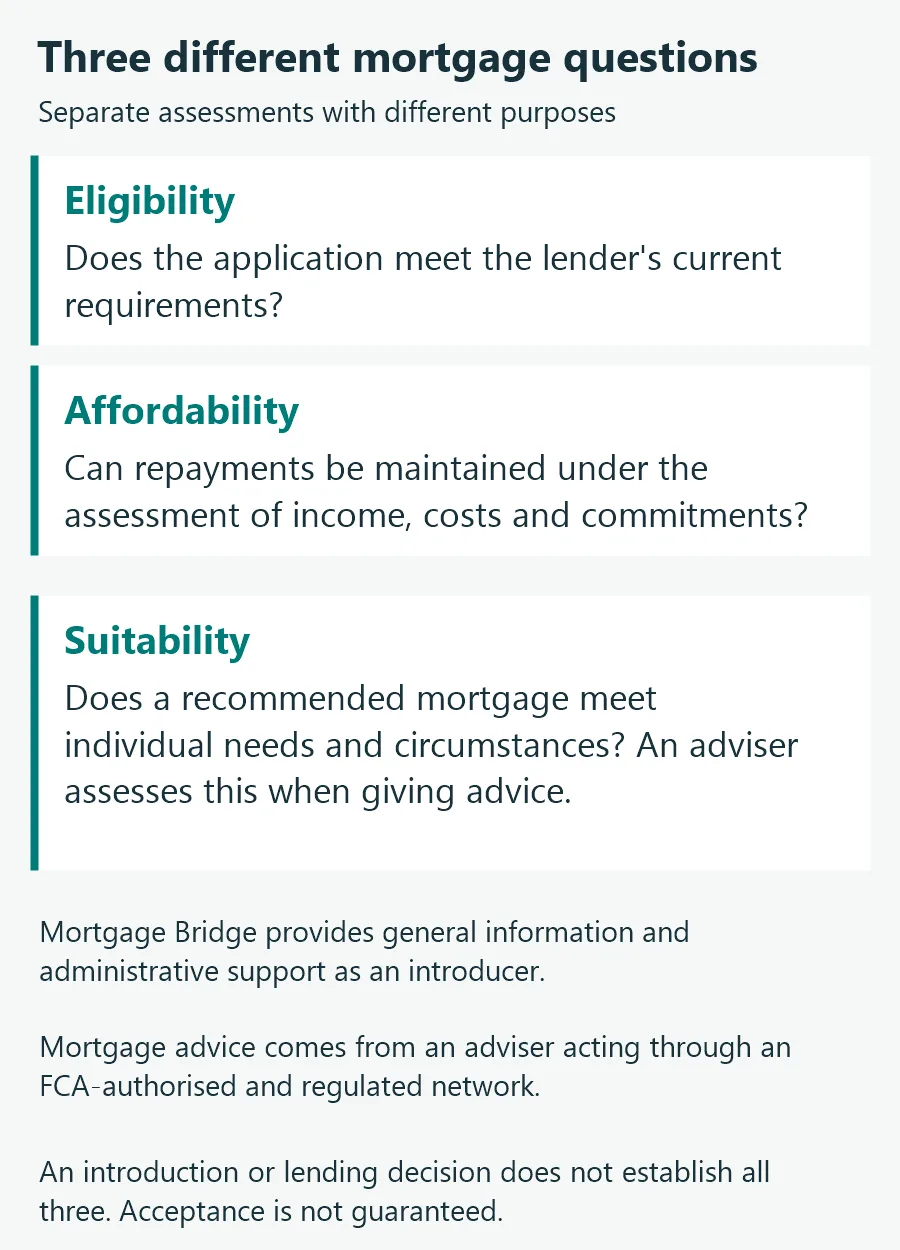
Eligibility concerns a lender’s current requirements. Affordability concerns whether repayments can be maintained, taking account of relevant income, expenditure and commitments. Suitability concerns whether a recommended mortgage meets individual needs and circumstances and is assessed when an adviser acting through an FCA-authorised and regulated network provides mortgage advice. Meeting one assessment does not establish the others. Mortgage Bridge does not carry out these assessments.
Costs and independent debt support
Free, independent debt advice is available through MoneyHelper’s debt advice locator. This guide does not recommend changing debt repayments, using savings or taking additional credit to obtain a mortgage.
Securing previously unsecured debts against a home increases the risk to the home. Lower monthly payments do not necessarily mean lower total costs. Longer repayment terms and fees can increase the total amount repaid.
Referral disclosure
Mortgage Bridge has commercial relationships with receiving firms and receives a percentage of the adviser’s commission when an introduced case completes. An introduction does not guarantee acceptance or completion.
Read about us, our terms and conditions and our privacy policy.
Frequently asked questions
Does meeting one criterion guarantee a mortgage offer?
No. The lender assesses the complete application, including credit, affordability, property and other requirements. Acceptance is not guaranteed.
Does Mortgage Bridge assess eligibility or recommend a mortgage?
No. Mortgage Bridge provides general information and administrative support as a mortgage introducer. It does not assess eligibility, affordability or suitability or provide mortgage or debt advice. Mortgage advice comes from an adviser acting through an FCA-authorised and regulated network.
Sources and review
- FCA Handbook: responsible lending
- FCA Handbook: mortgage advice and suitability
- TransUnion: account information and reporting
- ICO: credit records and accuracy
- MoneyHelper: consolidation risks
Last reviewed: . This article is subject to periodic review. Information and lender criteria may change. General information only; this is not a personal recommendation.
Check your credit in detail
View your full credit report
See your credit information from all three major credit reference agencies with Checkmyfile. Try it free, then it becomes a paid monthly subscription. You can cancel online anytime.
Check your credit report