

Adverse Credit Decision Trees: What Matters Most to Mortgage Lenders
Understanding how adverse credit decision trees work can help borrowers make sense of how mortgage lenders assess applications involving missed payments, defaults, or other credit issues. Rather than relying on a single factor, lenders typically follow structured decision-making processes to evaluate risk, affordability, and overall suitability. These decision trees are not always visible to applicants, but they play a key role in determining whether a mortgage application progresses or is declined.
Adverse credit does not automatically prevent someone from obtaining a mortgage, but it can influence the types of products available, deposit requirements, and interest rates. Lenders will assess a combination of credit history, income stability, existing commitments, and the details of any past financial difficulties. Each lender applies its own criteria, meaning outcomes can vary significantly between providers.
This guide explains what matters most within adverse credit decision trees, how lenders prioritise different factors, and what borrowers should understand before applying. It remains purely informational and does not provide mortgage advice.
What are adverse credit decision trees?
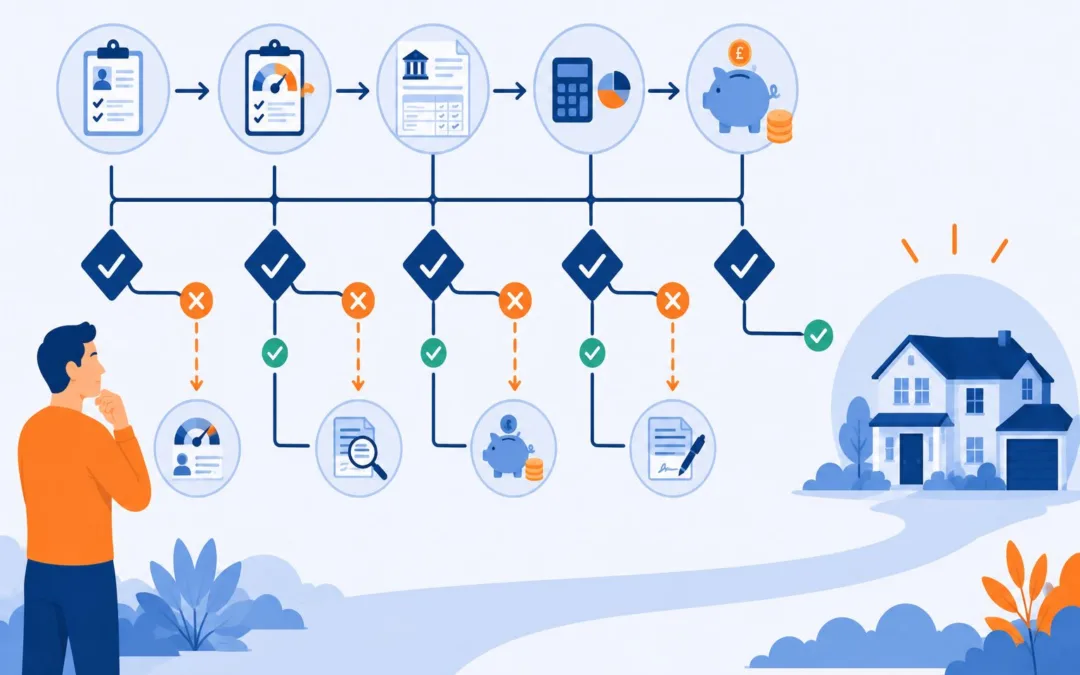
Adverse credit decision trees are structured frameworks lenders use to assess mortgage applications involving credit issues.
These decision trees typically break down an application into key checkpoints, such as credit history, income verification, affordability, and deposit size. At each stage, lenders apply rules or thresholds that determine whether the application proceeds. For example, a recent default may trigger stricter affordability checks or require a higher deposit.
Different lenders design their decision trees based on their risk appetite. Some may accept applicants with older credit issues, while others focus heavily on clean recent credit behaviour. This is why applicants with similar profiles can receive different outcomes depending on the lender’s criteria.
The decision tree approach allows lenders to assess applications consistently while still considering multiple variables. Rather than rejecting applications outright, some lenders may adjust terms, such as increasing interest rates or limiting loan-to-value ratios.
Which credit issues matter most to lenders?
Lenders prioritise the severity, frequency, and recency of credit issues when assessing applications.
Recent adverse events, such as missed payments within the last 12 months, often carry more weight than older issues. Lenders typically view recent behaviour as a stronger indicator of current financial reliability. For example, a default from five years ago may be less concerning than a missed payment from three months ago.
The type of credit issue also matters. County Court Judgments (CCJs), defaults, and bankruptcies are generally considered more serious than occasional late payments. Some lenders may decline applications with unresolved or recent CCJs, while others may accept them with stricter conditions.
Frequency plays a role as well. Multiple missed payments across different accounts can indicate ongoing financial strain. Lenders often assess patterns rather than isolated incidents, using decision trees to identify whether issues are systemic or one-off events.
How do lenders assess affordability with adverse credit?
Affordability remains a central part of adverse credit decision trees, even when credit issues are present.
Lenders will review income, regular outgoings, and existing debt commitments to determine whether repayments are manageable. Applicants with adverse credit may face more detailed affordability checks, including stress testing against higher interest rates to ensure resilience.
Expenditure analysis is particularly important. Lenders may scrutinise bank statements to identify spending habits and financial management. Consistent savings behaviour or reduced discretionary spending can positively influence the assessment.
In some cases, adverse credit can reduce the maximum borrowing amount available. Even if an applicant meets standard affordability criteria, lenders may apply more conservative limits to offset perceived risk.
Need help with your mortgage?
See what mortgage options may be available
If this guide sounds like your situation, send a few details and we can help organise the key information before introducing you to an FCA-regulated mortgage adviser where appropriate.
Make a mortgage enquiryNo obligation. Mortgage Bridge acts as a mortgage introducer.
What role does deposit size play in decision trees?
A larger deposit can improve outcomes within adverse credit decision trees by reducing lender risk.
Loan-to-value (LTV) is a key factor in mortgage assessments. Applicants with adverse credit are often required to provide larger deposits, sometimes 15% or more, depending on the severity of their credit history. Lower LTV ratios reduce potential losses for lenders if repayments are not maintained.
A higher deposit may also open access to a wider range of lenders or more competitive interest rates. Some lenders use deposit thresholds within their decision trees, meaning certain products are only available above specific deposit levels.
For buy-to-let mortgages, deposit requirements are typically higher even without adverse credit. When credit issues are present, lenders may also consider rental yield calculations and stress testing alongside the deposit amount.
How does time since adverse credit affect decisions?
The time elapsed since a credit issue is a major factor in lender decision-making.
Many lenders apply time-based rules within their decision trees. For example, they may require defaults or CCJs to be at least two to three years old before considering an application. Older issues are generally seen as less indicative of current financial behaviour.
Applicants who demonstrate improved financial management since the adverse event may be viewed more favourably. This could include maintaining up-to-date payments, reducing outstanding debts, and avoiding new credit issues.
Some lenders specialise in recent adverse credit, but this often comes with higher interest rates or stricter affordability requirements. Over time, as credit profiles improve, more options may become available.
How do lenders assess different borrower scenarios?
Lenders use decision trees to evaluate borrower profiles based on multiple combined factors.
For example, a borrower with a stable income, a large deposit, and a single historic default may be assessed differently from someone with multiple recent missed payments and high existing debt. Decision trees help lenders weigh these variables against each other rather than relying on a single metric.
Employment type can also influence outcomes. Applicants with permanent employment and consistent income may be viewed as lower risk compared to those with variable or self-employed income, although lenders will assess each case individually.
Additional factors such as property type, loan size, and intended use (residential or buy-to-let) may also be included in the decision process. Each element feeds into the overall risk profile assessed by the lender.
Practical example: how a lender may assess an application
A practical borrower scenario helps illustrate how adverse credit decision trees operate in real terms.
Consider a borrower applying for a residential mortgage with a 20% deposit, a stable salary, and a default registered three years ago. The lender’s decision tree may first assess the recency of the default, determining that it falls outside a high-risk timeframe.
Next, the lender may evaluate affordability, reviewing income and expenditure to ensure repayments are sustainable. If the borrower demonstrates strong financial management since the default, this may positively influence the outcome.
Finally, the lender may adjust terms to reflect the previous credit issue, such as offering a slightly higher interest rate or limiting borrowing. Another lender with different criteria may assess the same case differently, highlighting the variability in decision-making processes.
What risks do lenders consider in adverse credit cases?
Lenders focus on the risk of missed repayments and potential financial instability.
Adverse credit signals a higher probability of repayment difficulties, which lenders aim to mitigate through their decision trees. This includes evaluating whether past issues are likely to reoccur based on current financial circumstances.
Market factors can also play a role. For example, lenders may apply stricter criteria during periods of economic uncertainty, particularly for applicants with weaker credit profiles. This can affect approval rates and available mortgage products.
Risk management may involve limiting loan sizes, requiring higher deposits, or applying stricter affordability tests. These measures are designed to protect both the lender and the borrower from unsustainable borrowing.
FAQ: Adverse Credit Decision Trees
Can you get a mortgage with adverse credit?
It may be possible, depending on the type, severity, and timing of the credit issue. Lenders assess each application using their own criteria, and outcomes can vary.
Do all lenders use the same decision trees?
No, each lender has its own decision-making framework. Criteria, risk tolerance, and product availability differ across the market.
How long after a default can you apply for a mortgage?
Some lenders may consider applications after two to three years, although this depends on the overall credit profile and financial circumstances.
Does a bigger deposit improve approval chances?
A larger deposit can reduce lender risk and may improve the likelihood of acceptance or access to better mortgage terms.
Will adverse credit affect mortgage interest rates?
Yes, applicants with adverse credit may be offered higher interest rates to reflect the increased risk perceived by lenders.
This guide provides general information only. Personalised mortgage advice should always come from a regulated mortgage adviser authorised by the Financial Conduct Authority.
Check your credit in detail
View your full credit report
See your credit information from all three major credit reference agencies with Checkmyfile. Try it free, then it becomes a paid monthly subscription. You can cancel online anytime.
Check your credit report
Important information: Mortgage Bridge provides information only and acts as a mortgage introducer. We do not provide mortgage advice or make lender recommendations. We can introduce you to an FCA-regulated mortgage adviser who can provide personalised mortgage advice.