


Mortgage Bridge provides general information and administrative support as a mortgage introducer. It does not provide mortgage or debt advice, assess eligibility, affordability or suitability, or recommend products. Mortgage advice comes from an adviser acting through an FCA-authorised and regulated network.
Your home may be repossessed if you do not keep up repayments on your mortgage.
Securing previously unsecured debts against a home increases the risk to the home. Lower monthly payments do not necessarily mean lower total costs. Longer repayment terms and fees can increase the total amount repaid.
Criminal records and underwriting raise separate questions about lawful disclosure and the lender’s requirements. Underwriting assesses an application against those requirements rather than promising a way around them.
This guide focuses on the different checks rather than claiming that underwriters can see every record or focus only on repayment behaviour. Evidence about income, funds and current obligations may have its own significance. An explanation does not establish approval.
Criminal records and underwriting: law and lender policy
An applicant’s disclosure obligations and a lender’s lawful assessment are separate questions. The lender’s questions, permitted criteria, available evidence and full circumstances need to be understood. There is no reliable general claim that all lenders disregard a certain offence or that a specialist lender will accept a particular criminal history.
Age of an event, its financial consequences and present commitments may be relevant without creating a guaranteed outcome. An explanation can provide context but cannot require approval. This article does not rank offences into universal mortgage acceptance bands. It also does not use another person’s successful purchase as evidence that the same result is available to a reader with apparently similar circumstances.
The wording of disclosure questions matters
Mortgage application questions can concern identity, finances, occupation, deposit source and other matters relevant to the lender. Responses need to reflect what is lawfully required and the actual circumstances. A question about a financial commitment is not the same as a question about a criminal conviction, and a broad reference to honesty does not remove statutory disclosure protections.
Where a question is unclear, its legal meaning and the lender’s requirements need clarification. This article cannot decide whether a particular conviction is spent or whether an exception applies. It does not recommend concealing required information or volunteering protected records. An adviser’s explanation of the application process and specialist legal advice about disclosure are distinct services.
Spent and unspent convictions
Spent status is determined by the applicable rehabilitation law and the sentence or disposal, not simply by calling an offence minor, historic or serious. The Ministry of Justice guidance for England and Wales explains that spent convictions generally do not have to be disclosed for mortgage applications. Where an applicant is asked about convictions and continues, unspent convictions must be disclosed as required.
Rehabilitation periods, exceptions and legal rules can differ by jurisdiction and circumstances. A fixed number of years since the offence is therefore not a reliable rule for every person. Being spent does not erase separate accurate financial records or cancel an outstanding liability. This guide does not determine individual legal status or give a universal mortgage waiting period after conviction.
A credit search is not a criminal-record check
A credit file and a criminal record are different information systems. Ordinary credit information includes account conduct, address information and relevant public financial records. A lender may also make identity or fraud-related checks under its process. It is unsafe to assume that a credit search is a complete criminal-record search or that it reveals nothing else relevant to an application.
Financial consequences can appear separately, such as a court judgment, insolvency or current repayment obligation. Fraud-prevention information also has its own purpose and correction process. A conviction, a civil judgment and a fraud marker are not interchangeable. This guide does not promise what a particular lender can see or recommend relying on a clean consumer report instead of answering lawful questions accurately.
Evidence of where purchase money comes from
The lender and conveyancer can ask about savings, sale proceeds, inheritance, gifts and other sources. Their checks serve different responsibilities and one professional’s acceptance does not automatically satisfy the other. A balance at one date can show that money is present without explaining how it accumulated or who ultimately owns it.
Supporting records may need to trace a transfer back to its origin, including where another person is providing funds. Borrowed money and money subject to repayment or ownership conditions cannot simply be described as an unconditional gift. The SRA explains why identity and source-of-funds checks are required. Their scope depends on the transaction; there is no guaranteed exemption because the parties know one another.
What income evidence can establish
Payslips, employment records, tax documents or business accounts can explain where earnings come from and how they are paid. The appropriate evidence depends on the source and the lender. Some information can be verified electronically; other applications require documents or clarification. There is no single document list or number of payslips that applies to every borrower.
Evidence of money received is not automatically evidence that it is recurring personal income. An account credit could be a transfer, reimbursement, loan or business receipt. A lender may need to distinguish these from earnings available for mortgage payments. A clear explanation can resolve a question about a record, but it does not oblige the lender to accept the income.
Need help with your mortgage?
What happens after a mortgage enquiry?
This is an initial enquiry for administrative support and an adviser introduction where appropriate. It is not a mortgage application or an eligibility assessment. Any mortgage advice comes separately from an adviser acting through an FCA-authorised and regulated network. The receiving firm explains its service, fees and information requirements.
Mortgage Bridge has commercial relationships with receiving firms and receives a percentage of the adviser’s commission when an introduced case completes. Acceptance is not guaranteed.
Ask about an adviser introduction
Send details of your enquiry for administrative support and an adviser introduction where appropriate. Mortgage Bridge does not provide mortgage or debt advice, assess eligibility, affordability or suitability, or recommend products. Mortgage advice comes from an adviser acting through an FCA-authorised and regulated network.
Make a mortgage enquiryNo obligation. Mortgage Bridge acts as a mortgage introducer.
Mortgage Bridge has commercial relationships with receiving firms and receives a percentage of the adviser’s commission when an introduced case completes.
Your home may be repossessed if you do not keep up repayments on your mortgage.
How affordability differs from a headline income figure
Income establishes only part of a mortgage assessment. The lender also considers expenditure, existing financial commitments and relevant foreseeable changes under the rules that apply to the loan. Gross salary, take-home pay and the income a lender recognises are different figures. An online borrowing estimate cannot establish which amount will be accepted.
An income multiple can be a limit within a lender’s policy without being the amount it will offer. Property value, credit requirements and the requested term can impose separate restrictions. Two applicants earning the same amount can receive different decisions because their costs and circumstances differ. This guide does not set a universal salary threshold or promise a particular advance.
Eligibility, affordability and suitability
Visual explanation: eligibility, affordability and suitability
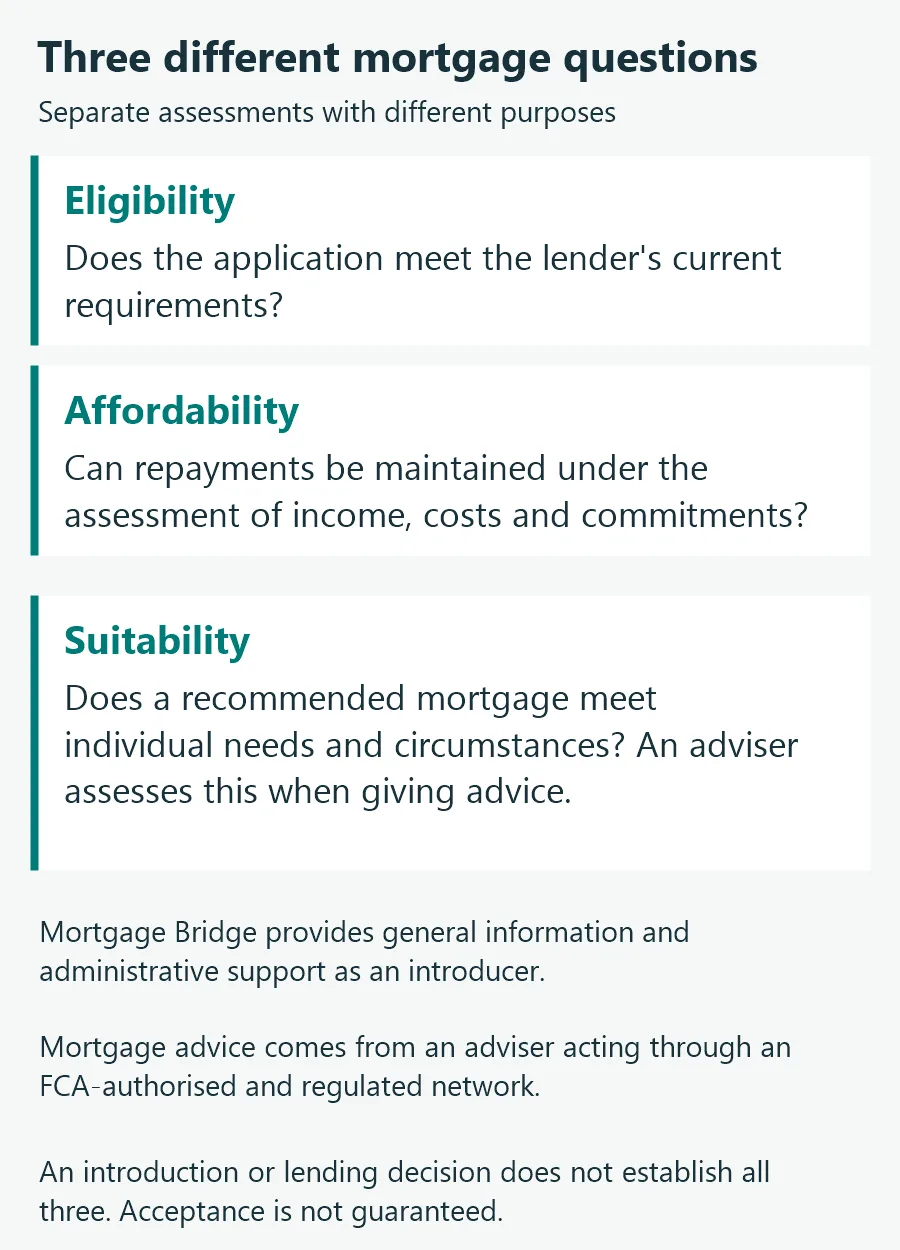
Eligibility means meeting a lender’s current requirements. Affordability concerns maintaining payments under the relevant assessment of income, costs and commitments. Suitability concerns whether a recommended mortgage meets an individual’s needs and circumstances; an adviser assesses this when giving advice. An initial check, valuation or lender approval does not establish all three.
The outcome depends on individual circumstances, supporting evidence, affordability, the property and lender criteria. Acceptance is not guaranteed.
Debt support and Mortgage Bridge’s role
Free, independent debt advice is available through MoneyHelper’s debt advice locator. This guide does not recommend changing debt repayments, taking new credit or using savings to obtain a mortgage.
Any review by Mortgage Bridge is administrative only. An introduction is not a lending decision or a personal recommendation. Mortgage Bridge has commercial relationships with receiving firms and receives a percentage of the adviser’s commission when an introduced case completes.
Read about us, our terms and conditions and our privacy policy.
Frequently asked questions
Is underwriting a guarantee that a complex case will be accepted?
No. It is an assessment against requirements, not an assurance of an exception.
Can a credit search be assumed to reveal the full criminal record?
No. Credit information and criminal-record systems have different purposes and content.
Does meeting eligibility criteria establish affordability or suitability?
No. Eligibility concerns lender requirements; affordability concerns the ability to maintain payments; suitability concerns the individual needs assessed when an adviser makes a recommendation. These are separate questions.
Does Mortgage Bridge give personal mortgage or debt advice?
No. Mortgage Bridge provides general information and administrative support as an introducer. It does not assess eligibility, affordability or suitability or recommend products. Mortgage advice comes from an adviser acting through an FCA-authorised and regulated network.
Sources and review
- Ministry of Justice: rehabilitation and mortgage/insurance disclosure
- Halifax: mortgage, deposit, conviction and property criteria (one lender’s policy)
- FCA: responsible lending and affordability
- SRA: identity and source-of-funds checks
- ICO: credit records, checks and inaccurate information
- Scottish Government: rehabilitation and self-disclosure
- MoneyHelper: applying for a mortgage
- Nationwide: employment income criteria (one lender’s policy)
- Nationwide: self-employed income evidence (one lender’s policy)
- Nationwide: affordability criteria (one lender’s policy)
- FCA: advised mortgage sales and suitability
- MoneyHelper: secured debt and consolidation costs
Lender pages illustrate individual policies, not universal requirements or recommendations.
Last reviewed: . This article is subject to periodic review. Information, rules and lender criteria may change.
Check your credit in detail
View your full credit report
See your credit information from all three major credit reference agencies with Checkmyfile. Try it free, then it becomes a paid monthly subscription. You can cancel online anytime.
Check your credit report