


DMP records describe accounts and arrangements connected with a Debt Management Plan. Plan status, credit records and continuing repayments are separate factors in a mortgage assessment. Completing a plan does not automatically remove credit records or establish affordability.
Availability depends on individual circumstances, supporting evidence, affordability and the lender’s current criteria. Neither DMP completion nor elapsed time guarantees acceptance.
What is a DMP?
A DMP is an informal arrangement with creditors for repaying unsecured debts, often through reduced monthly payments. It can be arranged directly with creditors or through a provider. It is different from a formal insolvency procedure such as an Individual Voluntary Arrangement or bankruptcy.
Creditors do not have to agree to a DMP or freeze interest and charges. Unless the agreement provides otherwise, they may still seek repayment or take recovery action even where agreed payments are maintained.
This article does not recommend starting, changing or ending a plan. Questions about an existing DMP’s terms and payments can be discussed with its provider or an independent debt adviser.
DMP records and plan status are different
An active DMP involves continuing debt repayments. Completion describes the end of the plan, but the position of each account and how it was resolved still matter.
A lender may request confirmation of the plan’s status, start and completion dates, payments and remaining balances. Completion evidence is different from a credit report: neither should be assumed to describe every aspect of the other.
There is no universal mortgage timetable for an active, recently completed or older DMP. An explanation of previous difficulties does not override lending criteria.
How can a DMP appear on a credit report?
A DMP is not normally recorded as a separate entry in the way that a public insolvency record is. Individual accounts can show reduced payments, arrangement markers, missed payments or defaults. Creditors may also add a DMP flag to an account.
Different entries have different reporting dates. A default normally remains for six years from its default date, even if the debt is repaid during that period. Other account information has its own reporting history and relevant dates.
There is no single date when every record connected with a DMP disappears. Completion does not automatically remove accurate adverse information or make all accounts “partially settled”. Account entries need to reflect how each debt was actually resolved.
Inaccurate information can be raised with the relevant credit reference agency and the organisation that supplied it. A correction does not guarantee a particular credit score or mortgage outcome.
Why do continuing commitments matter?
A mortgage assessment involves more than the label attached to a debt arrangement. Where repayments continue, they form part of the financial circumstances that need to be understood alongside income, household expenditure and other commitments.
Under applicable FCA rules, lenders assess whether repayments can be maintained using relevant income and expenditure information. Assessment methods and evidence requirements vary. A lower DMP payment is not evidence on its own that an additional mortgage payment would be affordable.
The terms of an active DMP may also restrict further borrowing. A mortgage enquiry does not change those terms or establish that additional borrowing is permitted.
What other information may a lender consider?
Depending on its criteria and the application, a lender may consider:
- The plan’s status, payments, balances and supporting records.
- Credit information linked to the plan and other accounts.
- Evidence of income and expenditure.
- The deposit or equity and source of funds.
- The property, proposed loan and repayment term.
There is no standard deposit percentage or credit-utilisation target that guarantees acceptance. A larger deposit does not remove the need for credit and affordability assessments.
Describing a lender as “specialist” does not establish that it will consider an application or that its products would be suitable. Recent payment history does not guarantee that previous difficulties will be disregarded.
Need help with your mortgage?
What happens after a mortgage enquiry?
This is an initial enquiry for administrative support and an adviser introduction where appropriate. It is not a mortgage application or an eligibility assessment. Any mortgage advice comes separately from an adviser acting through an FCA-authorised and regulated network. The receiving firm explains its service, fees and information requirements.
Mortgage Bridge has commercial relationships with receiving firms and receives a percentage of the adviser’s commission when an introduced case completes. Acceptance is not guaranteed.
Ask about an adviser introduction
Send details of your enquiry for administrative support and an adviser introduction where appropriate. Mortgage Bridge does not provide mortgage or debt advice, assess eligibility, affordability or suitability, or recommend products. Mortgage advice comes from an adviser acting through an FCA-authorised and regulated network.
Make a mortgage enquiryNo obligation. Mortgage Bridge acts as a mortgage introducer.
Mortgage Bridge has commercial relationships with receiving firms and receives a percentage of the adviser’s commission when an introduced case completes.
Your home may be repossessed if you do not keep up repayments on your mortgage.
Eligibility, affordability and suitability are different
Visual explanation: eligibility, affordability and suitability
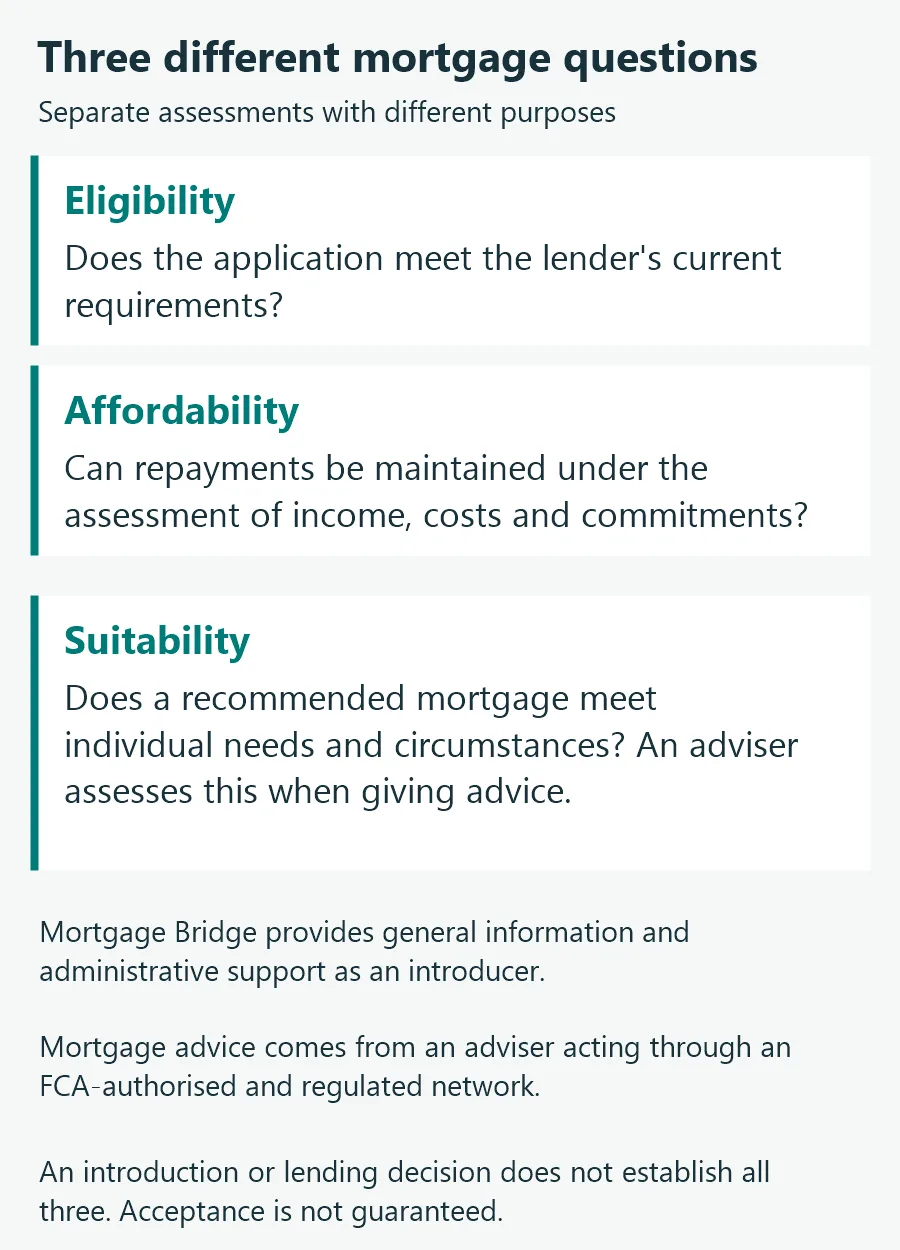
- Eligibility: whether an application meets a lender’s requirements, including its credit-history, property and borrowing criteria. Meeting initial criteria does not guarantee an offer.
- Affordability: whether repayments can be maintained, assessed under applicable rules using relevant financial information.
- Suitability: whether a mortgage recommendation is appropriate for an individual’s needs and circumstances. When mortgage advice is provided, this is assessed by an adviser acting through an FCA-authorised and regulated network.
DMP completion, a credit-score change or a lender’s willingness to lend does not establish all three.
Risks of replacing DMP debts with mortgage borrowing
Securing previously unsecured debts against a home increases the risk to the home. Lower monthly payments do not necessarily mean lower total costs: a longer repayment term and fees can increase the total amount repaid.
Replacing debts with mortgage borrowing creates a new secured commitment. A reduced monthly payment does not establish affordability or suitability.
This guide does not recommend settling or partly settling debts, changing DMP payments or using savings to improve mortgage prospects. Free, independent debt advice can explain options, including alternatives that do not involve securing further borrowing against a home.
Mortgage Bridge’s role and referral payment
Mortgage Bridge provides general information and administrative support and can introduce customers to an adviser. Any information review by Mortgage Bridge is administrative only; it is not a lending decision or an assessment of mortgage eligibility, affordability or suitability.
Mortgage Bridge does not manage DMPs or recommend debt-repayment arrangements.
Mortgage Bridge has commercial relationships with receiving firms and receives a percentage of the adviser’s commission when an introduced case completes. An introduction does not guarantee a mortgage offer or completion.
Read more about Mortgage Bridge, our terms and conditions and our privacy policy.
Frequently asked questions
Does completing a DMP establish mortgage eligibility?
No. Availability depends on individual circumstances, supporting evidence, affordability and the lender’s current criteria. Completion does not establish suitability or guarantee acceptance.
Does a DMP appear as a separate insolvency record?
No. A DMP is an informal arrangement rather than a formal insolvency procedure. Individual credit accounts may show reduced payments, arrangement or DMP markers, missed payments or defaults.
No. Individual records have their own reporting dates. A default normally remains for six years from its default date, even if the debt is repaid during that period. Completion does not automatically remove accurate records.
Do reduced DMP payments prove that a mortgage is affordable?
No. Affordability depends on the wider financial circumstances, including income, expenditure and continuing commitments. A lower debt payment does not establish that an additional mortgage payment can be maintained.
Does Mortgage Bridge assess eligibility or recommend mortgages?
No. Mortgage Bridge provides general information and administrative support as a mortgage introducer. It does not assess eligibility or suitability or provide mortgage or debt advice. Mortgage advice comes from an adviser acting through an FCA-authorised and regulated network.
Sources and review date
- GOV.UK: Debt Management Plans
- Experian: DMPs and credit records
- Experian: defaults and reporting periods
- FCA Handbook: responsible lending
- FCA Handbook: mortgage advice and suitability
- MoneyHelper: debt consolidation risks and costs
Last reviewed: . Information and lender criteria may change. This article provides general information only and is not a personal recommendation.
Check your credit in detail
View your full credit report
See your credit information from all three major credit reference agencies with Checkmyfile. Try it free, then it becomes a paid monthly subscription. You can cancel online anytime.
Check your credit report