


Important information: Mortgage Bridge provides general information and administrative support as a mortgage introducer. It does not provide mortgage or debt advice, assess eligibility, affordability or suitability, or recommend products. Mortgage advice comes from an adviser acting through an FCA-authorised and regulated network.
Your home may be repossessed if you do not keep up repayments on your mortgage.
Further credit checks may use updated information during an application or before completion. A lender may carry out further checks during a mortgage application or before completion. Those checks can involve updated credit information, supporting documents or questions about changes in circumstances.
A further check does not automatically mean the application will be declined. Equally, an earlier decision in principle does not guarantee a final mortgage offer, and issuing an offer is different from completing the mortgage.
Further credit checks: a Decision in Principle, an Offer and Completion Are Different Stages
Decision or Agreement in Principle
A decision in principle is an initial indication based on the information and checks used at that stage. It is not a final mortgage offer.
The full application may require additional evidence, further credit assessment, a property valuation and legal checks. Information considered later may differ from what was available initially.
Formal Mortgage Offer
A formal offer sets out the proposed mortgage terms, any conditions and an expiry date. It should not be treated as an informal approval that a lender can freely disregard.
However, an offer can contain conditions and circumstances in which the lender may withdraw it. The wording of the offer and the facts of the case matter.
Completion
Completion is a separate stage involving the release and application of mortgage funds through the required process. An offer being issued does not confirm that all legal work and completion requirements have been satisfied.
Why Might Further Checks Take Place?
There is no universal rule that every lender conducts exactly two credit searches or repeats the same checks at a fixed point.
Further checks may be relevant where:
- More detailed assessment follows the decision-in-principle stage.
- New or updated information becomes available.
- The application changes or an offer extension is requested.
- The lender needs to verify information or investigate a discrepancy.
- A change in circumstances is reported.
The lender can explain its process and what information it requires. A request for further evidence is not, by itself, confirmation of a problem or a decline.
What Credit Information May Have Changed?
Relevant information could include new borrowing, changed balances, missed payments, defaults, court judgments or the updated status of an account.
Credit reports are not updated in real time. Information appearing in a later check may concern an earlier event rather than something that happened after the original assessment.
An entry may also be inaccurate or linked to the wrong person. The cause should be established rather than assuming that every change reflects new financial difficulties.
The lender may consider both its credit criteria and the effect of commitments on affordability. A change in a consumer credit score alone does not explain every lending decision.
New Borrowing and Changes to Commitments
A new loan, vehicle finance agreement or other commitment can change the information on which an application was assessed.
The effect depends on the agreement, required payments, lender criteria and wider circumstances. There is no universal amount of new borrowing that automatically causes an offer to be withdrawn.
If borrowing or commitments change while an application is progressing, tell the receiving adviser or lender and follow the application’s disclosure requirements. Do not assume that a change is irrelevant because repayments appear affordable to you.
Employment and Income Changes Are Separate from Credit Searches
A credit search does not normally provide a complete record of current earnings or employment. A lender may obtain information through updated income documents or other verification.
A job change, different contract, self-employment or a change in earnings may require assessment. None should be described as an automatic reason for refusal without checking the applicable requirements.
Report relevant changes accurately. This guide does not recommend delaying an employment decision or altering financial arrangements to influence a mortgage outcome.
Affordability and Other Lending Requirements
A lender may need to reconsider accepted income, expenditure and commitments where new information affects the application.
A satisfactory credit check does not establish affordability. Likewise, an affordability calculation does not require the lender to overlook a credit entry outside its criteria.
Further enquiries may also concern the property, valuation, title or deposit source. A decision made after a credit search should not automatically be attributed to that search without an explanation from the lender.
Soft and Hard Credit Searches
A soft search does not affect a consumer credit score and is not visible to other lenders in the same way as a hard application search. The organisation carrying it out can still use the information obtained in its assessment.
A hard search leaves an application-search record that other lenders may see and can affect a consumer score. The search itself is different from the account information or other evidence used to make a decision.
A soft search is not limited to monitoring, and it does not guarantee acceptance. The type of search used at a particular application stage varies.
If the Lender Requests More Information
Ask what needs to be clarified and which evidence is required. Relevant documents may include account statements, repayment confirmations, income evidence or an explanation of a discrepancy.
Provide accurate information through the receiving firm’s secure document-sharing process. Keep copies of documents and correspondence.
An explanation or corrected document can support a review, but it does not guarantee that the application will be accepted.
If the Application Is Declined or an Offer Is Withdrawn
Ask the lender what explanation it can provide and whether there is a review process. Establish whether the issue concerns credit information, affordability, verification, the property or another requirement.
If a formal offer is involved, ask the lender to identify the relevant condition or basis for its decision. The receiving adviser can help clarify the mortgage position, while a conveyancer or solicitor can explain legal implications.
Where credit information appears inaccurate, contact the reporting organisation and relevant credit reference agency. Correcting an error does not guarantee that all other lending requirements will be met.
Another lender may assess circumstances differently, but a decline does not establish that an alternative mortgage is available. Repeated applications are not a substitute for understanding the issue.
Need help with your mortgage?
What happens after a mortgage enquiry?
This is an initial enquiry for administrative support and an adviser introduction where appropriate. It is not a mortgage application or an eligibility assessment. Any mortgage advice comes separately from an adviser acting through an FCA-authorised and regulated network. The receiving firm explains its service, fees and information requirements.
Mortgage Bridge has commercial relationships with receiving firms and receives a percentage of the adviser’s commission when an introduced case completes. Acceptance is not guaranteed.
Ask about an adviser introduction
Send details of your enquiry for administrative support and an adviser introduction where appropriate. Mortgage Bridge does not provide mortgage or debt advice, assess eligibility, affordability or suitability, or recommend products. Mortgage advice comes from an adviser acting through an FCA-authorised and regulated network.
Make a mortgage enquiryNo obligation. Mortgage Bridge acts as a mortgage introducer.
Mortgage Bridge has commercial relationships with receiving firms and receives a percentage of the adviser’s commission when an introduced case completes.
Your home may be repossessed if you do not keep up repayments on your mortgage.
Property-Purchase Commitments
If a purchase deadline is approaching, tell the conveyancer promptly about any change to the mortgage position.
In England and Wales, exchange of contracts normally creates a binding commitment. If funding becomes uncertain after exchange, urgent legal advice is needed about the contractual position and available options. Processes elsewhere in the UK differ.
Do not assume that an application review, complaint or proposed alternative mortgage will resolve matters before a deadline.
Reviews and Complaints
A request to review a lending decision is different from a complaint about how an application was handled.
If you believe the lender has made an error or treated you unfairly, use its complaints process. Where applicable, an eligible complaint may be referred to the Financial Ombudsman Service after the firm has had the opportunity to respond.
A review or complaint does not guarantee a mortgage offer, reinstatement of an offer or compensation.
Buy-to-Let Applications
Buy-to-let applications may also involve further checks. The lender may consider credit history, personal commitments, expected rent, other property borrowing and the proposed transaction.
The criteria differ from residential lending. Expected rental income does not remove the need for relevant verification, property checks or compliance with the lender’s requirements.
Frequently Asked Questions
Can an application be declined after a decision in principle?
Yes. A decision in principle is not a final mortgage offer. Further assessment and evidence may identify information affecting whether the application meets the lender’s requirements.
Does every lender carry out a second credit check?
There is no universal process involving exactly two checks. The timing, type and extent of further checks depend on the lender and application.
Can a formal mortgage offer be withdrawn?
In some circumstances, yes. The offer’s conditions and the facts matter. Ask the lender to explain the basis of its decision and seek appropriate advice about any purchase commitments.
Can information from a soft search affect the decision?
Yes. Although a soft search does not affect a consumer credit score, the organisation carrying it out can use the information obtained in its assessment.
Can a decline or withdrawal be reviewed?
Ask the lender about its review and complaints processes. Additional or corrected information may be considered, but a review does not guarantee acceptance or reinstatement of an offer.
How Mortgage Bridge Can Help
Mortgage Bridge provides general information and administrative support and passes mortgage enquiries to advisers acting through an FCA-authorised and regulated network. We do not assess eligibility, select lenders, recommend mortgage products or overturn lending decisions.
The receiving adviser can discuss your circumstances, explain their service and any fees, and assess potential mortgage options within the scope of that service. Legal questions about an offer or property-purchase commitments should be addressed by an appropriate legal adviser.
Any application remains subject to the lender’s criteria, checks and decision.
Mortgage Bridge has commercial relationships with receiving firms. When an introduced case completes, we receive a percentage of the commission earned by the adviser. We therefore have a financial interest in completed introductions.
Read more about our role on our About Us page, in our Terms and Conditions and in our Privacy Policy.
This guide provides general information only. It is not mortgage or legal advice and does not confirm eligibility or guarantee acceptance.
Your home may be repossessed if you do not keep up repayments on your mortgage.
Eligibility, affordability and suitability
Visual explanation: eligibility, affordability and suitability
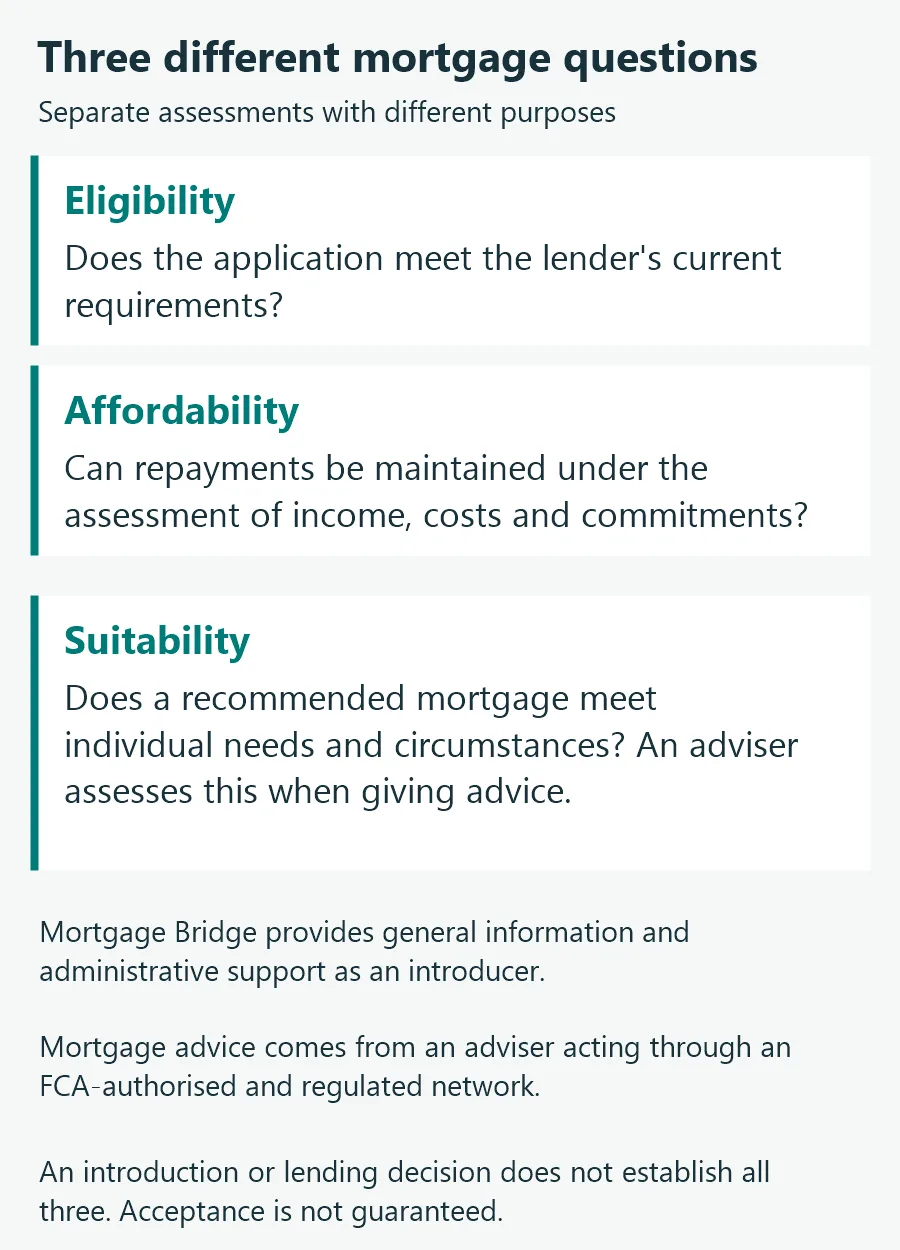
Eligibility concerns a lender’s current requirements. Affordability concerns whether repayments can be maintained, taking account of relevant income, expenditure and commitments. Suitability concerns whether a recommended mortgage meets individual needs and circumstances and is assessed when an adviser acting through an FCA-authorised and regulated network provides mortgage advice. Meeting one assessment does not establish the others. Mortgage Bridge does not carry out these assessments.
Costs and independent debt support
Free, independent debt advice is available through MoneyHelper’s debt advice locator. This guide does not recommend changing debt repayments, using savings or taking additional credit to obtain a mortgage.
Securing previously unsecured debts against a home increases the risk to the home. Lower monthly payments do not necessarily mean lower total costs. Longer repayment terms and fees can increase the total amount repaid.
Referral disclosure
Mortgage Bridge has commercial relationships with receiving firms and receives a percentage of the adviser’s commission when an introduced case completes. An introduction does not guarantee acceptance or completion.
Read about us, our terms and conditions and our privacy policy.
Sources and review
- FCA Handbook: responsible lending
- FCA Handbook: mortgage advice and suitability
- TransUnion: account information and reporting
- ICO: credit records and accuracy
- MoneyHelper: consolidation risks
Last reviewed: . This article is subject to periodic review. Information and lender criteria may change. General information only; this is not a personal recommendation.
Check your credit in detail
View your full credit report
See your credit information from all three major credit reference agencies with Checkmyfile. Try it free, then it becomes a paid monthly subscription. You can cancel online anytime.
Check your credit report