


Any property used as security, including your home, may be repossessed if you do not repay borrowing secured against it.
Your home may be repossessed if you do not keep up repayments on your mortgage.
Securing previously unsecured debts against a home increases the risk to the home. Lower monthly payments do not necessarily mean lower total costs. Longer repayment terms and fees can increase the total amount repaid. Where short-term borrowing has no monthly interest payments, the interest and capital still need to be repaid under the agreement.
Properties outside mortgage criteria can involve condition, construction, title or another issue. Describing a property as unmortgageable does not establish that bridging finance is available.
Some bridging products may permit particular properties or works that another lender will not accept. This does not mean bridging finance is available for every property declined for a standard mortgage.
Availability depends on the applicant, property, proposed works, legal position, repayment arrangements and current lender criteria. Acceptance is not guaranteed.
Properties outside mortgage criteria: what Does “Unmortgageable” Mean?
“Unmortgageable” is a general description, not a single property category with rules applying across all lenders.
A property may be unacceptable to one lender but assessed differently by another. Some issues may be capable of resolution; others may remain barriers to lending.
Relevant issues can include:
- Missing or non-functioning facilities.
- Structural defects or movement.
- Fire or flood damage.
- Non-standard construction.
- Lease length or lease conditions.
- Access, ownership or title problems.
- Planning, use or occupancy issues.
- Other condition, safety or valuation concerns.
These are examples, not automatic exclusions applying to every mortgage product or evidence that a bridging lender will accept the property.
How Might Bridging Finance Be Considered?
A proposed arrangement may involve short-term borrowing for a purchase or permitted works, with repayment expected from a later sale or refinancing.
The lender assesses the property in its current condition, the proposed project and the repayment plan under its own requirements.
It should not be assumed that a defect can be resolved within the loan term, that works will increase value or that another lender will refinance afterwards.
This guide does not recommend bridging finance as an alternative whenever a mortgage application is declined.
Condition Issues and Missing Facilities
Some products may permit particular refurbishment projects, subject to the scope of works and lender criteria.
A missing kitchen or bathroom, damage or poor condition may require assessment of the work, costs, safety, permissions and expected timescale.
The same description can cover very different problems. Cosmetic modernisation is not equivalent to structural repair, and a property being occupied does not establish that it meets a lender’s requirements.
A lender’s acceptance does not confirm that the property is safe to occupy or that all necessary works have been identified.
Structural Problems and Non-Standard Construction
Structural movement, subsidence, unusual construction or major damage may require specialist reports. The lender determines whether it will consider the property and what evidence is needed.
A repair estimate or contractor’s opinion does not guarantee that the underlying issue can be resolved or that another lender will accept the building.
Further investigation may identify additional work, cost or restrictions. Mortgage Bridge does not assess structural condition or certify repairs.
Lease, Title and Other Legal Issues
Some lending difficulties arise from the legal position rather than physical condition. Examples may involve a short lease, access rights, ownership disputes or restrictions on use.
Bridging borrowing does not resolve these issues by itself. A solicitor can explain whether a proposed solution is legally achievable, what permissions are needed and the associated costs and timescales.
A planned lease extension or title change should not be treated as completed or guaranteed.
Conversions and Development
Converting a building, changing its use or carrying out substantial structural work may involve different funding requirements from cosmetic refurbishment.
A lender may require planning information, building-control evidence, costings, a works schedule and details of the contractor or professional team.
Product definitions of refurbishment and development vary. Development exit finance should not be assumed to fund acquisition or construction works merely because it relates to a development project.
See our comparison of bridging loans and development finance.
Does the Loan Cover Repairs?
A purchase advance does not necessarily include the full repair or refurbishment budget.
Some facilities may provide a single advance, while others may include staged funding subject to conditions. Later releases can depend on inspections, valuations, evidence of expenditure or progress.
The borrower may need to contribute funds before or alongside the lender’s advances. Retained interest, fees and other deductions can also reduce the net funds available.
An agreed facility does not establish that every future drawdown is unconditional or that cost overruns will be funded.
Deposit, Equity and Security
There is no universal deposit percentage or loan-to-value range for properties described as unmortgageable.
Requirements may depend on the valuation basis, current condition, works, existing borrowing, fees, interest structure and the lender’s criteria.
A larger deposit does not guarantee acceptance or a lower rate. Additional property security may be considered by some lenders, but every property included can be exposed to enforcement if borrowing is not repaid.
See our guide to security for a bridging loan.
How May an Application Be Assessed?
Depending on the facility and transaction, relevant information may include:
- The property’s current value, condition and legal position.
- The purchase price and proposed borrowing.
- The applicant’s financial position and credit history.
- Deposit, equity and source of funds.
- Works budgets, permissions and schedules.
- Relevant borrower, contractor and professional-team experience.
- The proposed repayment source and supporting evidence.
Requirements vary. A projected end value, valuable security or clear explanation of the project does not override other criteria or guarantee approval.
Credit History and Experience
Some lenders may consider applicants with adverse credit or limited property experience, subject to their criteria and the project. Others apply restrictions.
A first-time buyer, first-time landlord and first-time developer are different circumstances. Lender definitions and experience requirements may differ.
Equity or a proposed exit does not outweigh credit requirements automatically. An experienced contractor does not necessarily satisfy a requirement for borrower experience.
Acceptance by the bridging lender does not establish acceptance by a future mortgage lender.
Auction Purchases and Completion Times
A property needing work may be offered at auction, but that does not confirm finance eligibility or readiness.
The auction contract determines the buyer’s obligations and deadlines. A solicitor should explain the specific terms and legal position.
Application timescales depend on valuation, surveys, legal work, supporting documents and satisfaction of lender conditions. No completion period is guaranteed.
An indicative lending decision is not confirmation that funds will be available by a purchase deadline.
See our guide to bridging finance for auction property.
Need help with bridging finance?
What happens after a bridging finance enquiry?
This is an initial enquiry for administrative support and an adviser introduction where appropriate. It is not a finance application or an eligibility assessment. Any regulated mortgage advice comes separately from an adviser acting through an FCA-authorised and regulated network. The receiving firm explains its service, fees and information requirements.
Mortgage Bridge has commercial relationships with receiving firms and receives a percentage of the adviser’s commission when an introduced case completes. Acceptance is not guaranteed.
Make a bridging finance enquiry
Send details of your enquiry for administrative support and an adviser introduction where appropriate. Mortgage Bridge does not provide mortgage or debt advice, assess eligibility, affordability or suitability, or recommend products. Any regulated mortgage advice comes from an adviser acting through an FCA-authorised and regulated network.
Make a bridging finance enquiryNo obligation. Mortgage Bridge acts as a bridging finance introducer.
Mortgage Bridge has commercial relationships with receiving firms and receives a percentage of the adviser’s commission when an introduced case completes.
Your home may be repossessed if you do not keep up repayments on your mortgage.
Can the Property Be Refinanced After Works?
That requires a separate assessment. Finishing repairs does not automatically make a property acceptable for a residential, buy-to-let or commercial mortgage.
The replacement lender may assess:
- The completed condition and valuation.
- Construction and any remaining defects.
- Title, lease and access requirements.
- Planning, use and completion documents.
- Relevant rental and licensing requirements.
- The applicant’s income, finances and credit history.
- Ownership-period or recent-works requirements.
A Decision in Principle is not a guaranteed offer or completion. The amount available may also be lower than expected and insufficient to repay the bridge and associated costs.
Criteria, valuations and the applicant’s circumstances may change before refinancing is needed.
Repayment Through a Sale
A lender may consider a proposed sale, subject to its criteria and evidence requirements.
Completing work does not guarantee a buyer, price, profit or completion date. The net proceeds may be reduced by existing debts, selling costs and other applicable payments.
The amount needed to repay the bridge may include principal, accrued interest, financed fees and other contractual charges.
See our guide to bridging exit strategies.
Costs and Interest
Depending on the facility, charges may include interest, arrangement fees, valuations, specialist reports, legal costs, inspections, broker fees and other contractual charges.
Interest may be serviced, retained or rolled up. The structure affects cash flow, the net advance and the final repayment balance.
Specialist investigations, additional works or legal complications may create costs outside the lender’s quotation. Refinancing can involve another set of fees.
A headline monthly rate does not show the total cost. Delays, minimum interest and exit or extension provisions may also affect the amount payable.
See our guide to bridging costs, fees and interest.
What Happens If the Problems Cannot Be Resolved?
Works may uncover further defects, permissions may not be obtained or a legal issue may remain unresolved. Costs and timescales can change.
If the property cannot be sold or refinanced as planned, the obligation to repay the bridge remains.
Consequences may include further interest and charges, default provisions, enforcement action and repossession. A sale may leave a shortfall, and guarantees may create additional liabilities.
An extension, replacement facility or further advance is not guaranteed. If repayment difficulties are expected, contact the lender promptly.
Buy-to-Let Proposals
A proposed rental property must meet the relevant letting requirements as well as the replacement lender’s criteria. These are separate from the bridging lender’s assessment.
Repairs, conversion work or a proposed increase in rent do not establish permission to let, licensing compliance, accepted rental income or mortgage availability.
This guide does not recommend buying a property to refurbish and let.
See our guide to bridging finance for buy-to-let investors.
Regulation and Suitability
The regulatory position depends on the borrower, property use and transaction structure. Poor condition, an investment description or a short loan term does not by itself determine whether an agreement is regulated.
An authorised firm may offer facilities that do not carry the same protections as a regulated residential mortgage.
The receiving firm should explain its role, the agreement’s regulatory status, fees and relevant complaints arrangements. Independent legal, surveying and other specialist advice may be needed about the property, works and security.
Suitability depends on individual circumstances and should be assessed by an appropriately qualified adviser. This guide does not recommend bridging finance as a solution to a property defect or mortgage refusal.
Eligibility, affordability and suitability
Visual explanation: eligibility, affordability and suitability
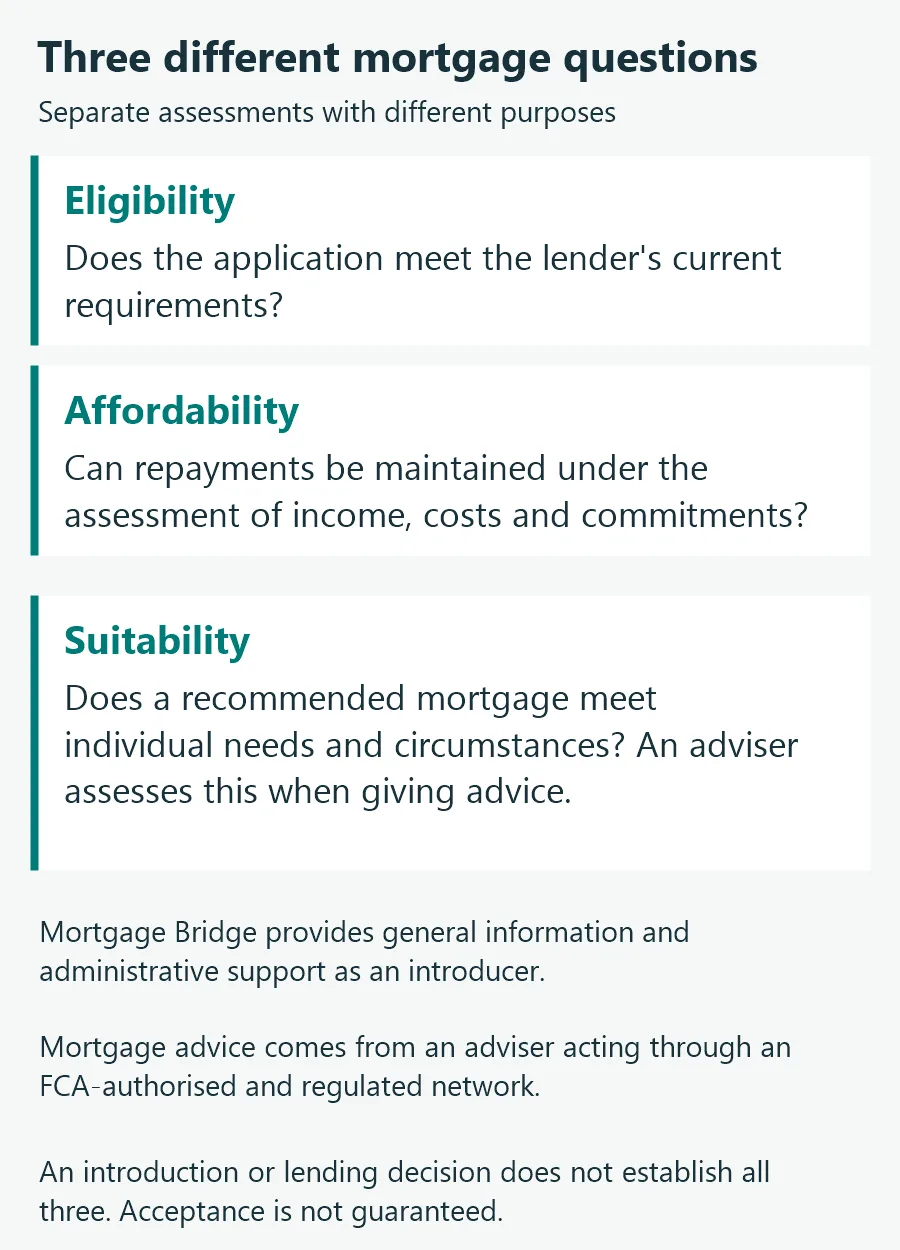
- Eligibility: whether the applicant, property, purpose and repayment proposal meet a lender’s current requirements.
- Affordability: the ability to meet applicable payments and commitments, taking account of income, expenditure and relevant foreseeable changes. Assessment methods depend on the facility, repayment structure and applicable rules.
- Suitability: whether a proposed recommendation meets an individual’s needs and circumstances. Where regulated mortgage advice is provided, this is assessed by an adviser acting through an FCA-authorised and regulated network.
Acceptance of security or an exit strategy does not by itself establish affordability or suitability. Mortgage Bridge assesses none of these. An explanation of previous credit issues, a larger contribution or a purchase deadline does not guarantee acceptance.
Debt support and Mortgage Bridge’s role
If repayment difficulties are expected, contact the lender promptly. Free, independent debt advice is available through MoneyHelper’s debt advice locator. For business-debt support, Business Debtline explains its free services and the areas it covers.
Mortgage Bridge can introduce enquiries to an adviser. Any review of documents or enquiry information is administrative only; it is not a lending decision or an assessment of eligibility, affordability or suitability. The receiving firm explains its services, fees and whether it can assist. An introduction does not guarantee an offer or completion.
Mortgage Bridge has commercial relationships with receiving firms and receives a percentage of the adviser’s commission when an introduced case completes. Mortgage Bridge therefore has a financial interest in introduced cases completing.
Read about us, our terms and conditions and our privacy policy.
Frequently asked questions
Does a property declined for a standard mortgage qualify automatically for bridging?
No. The bridging lender applies its own property, legal, financial and repayment requirements.
Does completing repairs establish mortgage eligibility?
No. A later lender separately assesses condition, valuation, legal requirements and the applicant.
Does bridging borrowing itself resolve a title or structural defect?
No. The underlying issue needs its own legal or professional assessment and any necessary work. A loan does not certify that it can be resolved.
Does Mortgage Bridge assess eligibility or give mortgage advice?
Mortgage Bridge provides general information and administrative support as a mortgage introducer. It does not provide mortgage or debt advice, assess eligibility, affordability or suitability, or recommend products. Mortgage advice comes from an adviser acting through an FCA-authorised and regulated network.
Sources and review
These sources explain the relevant rules, costs or individual lenders’ published approaches. A lender example does not establish that another lender uses the same criteria or that finance will be available.
- FCA Handbook: advising standards, suitability and bridging repayment strategies
- FCA Handbook: responsible lending, bridging exits and interest roll-up
- FCA Handbook: regulatory scope of mortgage activities
- Together: serviced, retained and rolled-up interest — one lender’s explanation
- United Trust Bank: bridging processes and security — one lender’s approach
- MoneyHelper: debt consolidation and security risks
- Shawbrook: development funding and drawdowns — one lender’s approach
- Financial Ombudsman Service: valuations and surveys
Last reviewed: . This article is subject to periodic review. Information, lender criteria, costs and regulatory requirements may change. General information only; this is not a personal recommendation.
Check your credit in detail
View your full credit report
See your credit information from all three major credit reference agencies with Checkmyfile. Try it free, then it becomes a paid monthly subscription. You can cancel online anytime.
Check your credit report