


Mortgage Bridge provides general information and administrative support as a mortgage introducer. It does not provide mortgage or debt advice, assess eligibility, affordability or suitability, or recommend products. Mortgage advice comes from an adviser acting through an FCA-authorised and regulated network.
Your home may be repossessed if you do not keep up repayments on your mortgage.
Securing previously unsecured debts against a home increases the risk to the home. Lower monthly payments do not necessarily mean lower total costs. Longer repayment terms and fees can increase the total amount repaid.
A lower property valuation than the agreed price can restrict borrowing or raise another property question. It does not establish an automatic negotiation outcome or alternative finance.
A lender considers a property as security as well as assessing the borrower. Physical condition, construction, legal rights and intended use can raise different questions, and one report does not settle them all.
This guide explains those checks without promising specialist lender access or a particular deposit. A property being marketed for sale, having a previous mortgage or meeting one lender’s requirements does not establish its acceptability for every new application.
Lower property valuation: the property must meet separate lending requirements
An applicant can satisfy initial financial checks while the property falls outside a lender’s policy. Construction, condition, title, location, use and marketability can all be relevant. The lender’s valuation and conveyancer’s legal review address different aspects of the proposed security. Neither is replaced by a larger deposit or a strong credit score.
A property previously financed by someone else is not automatically acceptable for a new application. Lender policy, building information and the property itself may have changed. A decline can concern a specific defect, missing evidence or a broader exclusion, but it does not establish that another lender must offer a solution. The actual reason and evidence determine what remains unresolved.
Legal title, permissions and the property assessment
The conveyancer examines ownership, rights, restrictions and other legal matters within the transaction. The valuer considers the property for the lender’s security assessment. A physical inspection cannot by itself establish every legal right, and a legal title entry does not establish the condition or value of the building.
Access rights, arrangements for maintenance, permissions for alterations and restrictions on occupation can need separate evidence. A lender may have requirements beyond those of the buyer. A seller’s statement or a property being advertised as residential is not a substitute for the relevant checks. This article does not recommend an indemnity policy, alteration or legal workaround; a conveyancer addresses the particular legal position.
A lender’s valuation is different from a buyer’s survey
A mortgage valuation addresses the property as security for the lender. It can use different methods and may not involve the level of inspection a buyer expects from a survey. A valuation does not certify that the building is free of defects, establish all repair costs or replace the conveyancer’s title checks.
The accepted value can differ from the agreed price or an estate agent’s estimate. Conditions, additional reports or legal information may affect the lender’s position. Paying for a valuation does not guarantee an offer. A buyer’s survey has its own scope, limitations and purpose; the appropriate service is a matter for the relevant professional rather than a mortgage approval outcome.
Condition, repairs and valuation retentions
A lender may require reports, completed repairs or other conditions before releasing all or part of an advance. A retention means some funds are held back under specified terms; it is different from an outright decline or a reduced valuation. The amount and conditions must come from the lender, not a generic illustration.
A seller may still expect the full price at completion, so a retention can create a funding gap. Later release can depend on evidence, inspection, time limits and the lender’s approval. A repaired property needs its current condition and relevant approvals established. This guide does not recommend short-term borrowing to bridge the gap or assume a retention will always be released after works.
Construction type, condition and supporting reports
A property description such as timber frame, concrete or prefabricated covers different systems, ages and conditions. The exact construction needs to be identified rather than assumed from a broad label. A lender may require information about durability, repairs, warranties or a particular building system before deciding whether the property meets its security requirements.
An engineer’s report, survey or warranty can address a particular question without guaranteeing mortgage availability. The property’s current condition, alteration history and marketability can still matter. This guide does not label every non-standard building unacceptable or promise a specialist lender. Nor does it assume a completed repair automatically satisfies each lender; the relevant records and current policy determine the assessment.
Deposit, price and loan-to-value
The purchase deposit is the part of the price not met by the mortgage advance. Loan-to-value compares borrowing with the value used by the lender, which may not equal the agreed price. Deposit size and the source of that deposit are separate questions. Neither a percentage nor a large cash balance establishes all lending requirements.
A lower valuation can increase the funding gap without changing what the seller wants to receive. Affordability can also restrict borrowing below a product’s maximum loan-to-value. Fees and purchase expenses may need additional funds. This guide therefore does not present a universal deposit range or suggest that a larger contribution automatically overrides income, credit, property or legal restrictions.
Need help with your mortgage?
What happens after a mortgage enquiry?
This is an initial enquiry for administrative support and an adviser introduction where appropriate. It is not a mortgage application or an eligibility assessment. Any mortgage advice comes separately from an adviser acting through an FCA-authorised and regulated network. The receiving firm explains its service, fees and information requirements.
Mortgage Bridge has commercial relationships with receiving firms and receives a percentage of the adviser’s commission when an introduced case completes. Acceptance is not guaranteed.
Ask about an adviser introduction
Send details of your enquiry for administrative support and an adviser introduction where appropriate. Mortgage Bridge does not provide mortgage or debt advice, assess eligibility, affordability or suitability, or recommend products. Mortgage advice comes from an adviser acting through an FCA-authorised and regulated network.
Make a mortgage enquiryNo obligation. Mortgage Bridge acts as a mortgage introducer.
Mortgage Bridge has commercial relationships with receiving firms and receives a percentage of the adviser’s commission when an introduced case completes.
Your home may be repossessed if you do not keep up repayments on your mortgage.
Mortgage fees and when they are payable
A mortgage can have a product or arrangement fee, valuation charges and other administration costs, depending on its terms. Adviser charges and legal costs may be separate. A zero-product-fee loan does not necessarily mean a cost-free application. Payment dates and refunds depend on the service or product and whether the transaction proceeds.
Where a fee is added to the mortgage, it becomes part of borrowing and can attract interest. Paying it upfront has a different cash requirement. Neither method is recommended here. The mortgage illustration and fee terms show the relevant amounts and assumptions; a comparison based only on the advertised rate can miss charges that materially affect the cost.
Eligibility, affordability and suitability
Visual explanation: eligibility, affordability and suitability
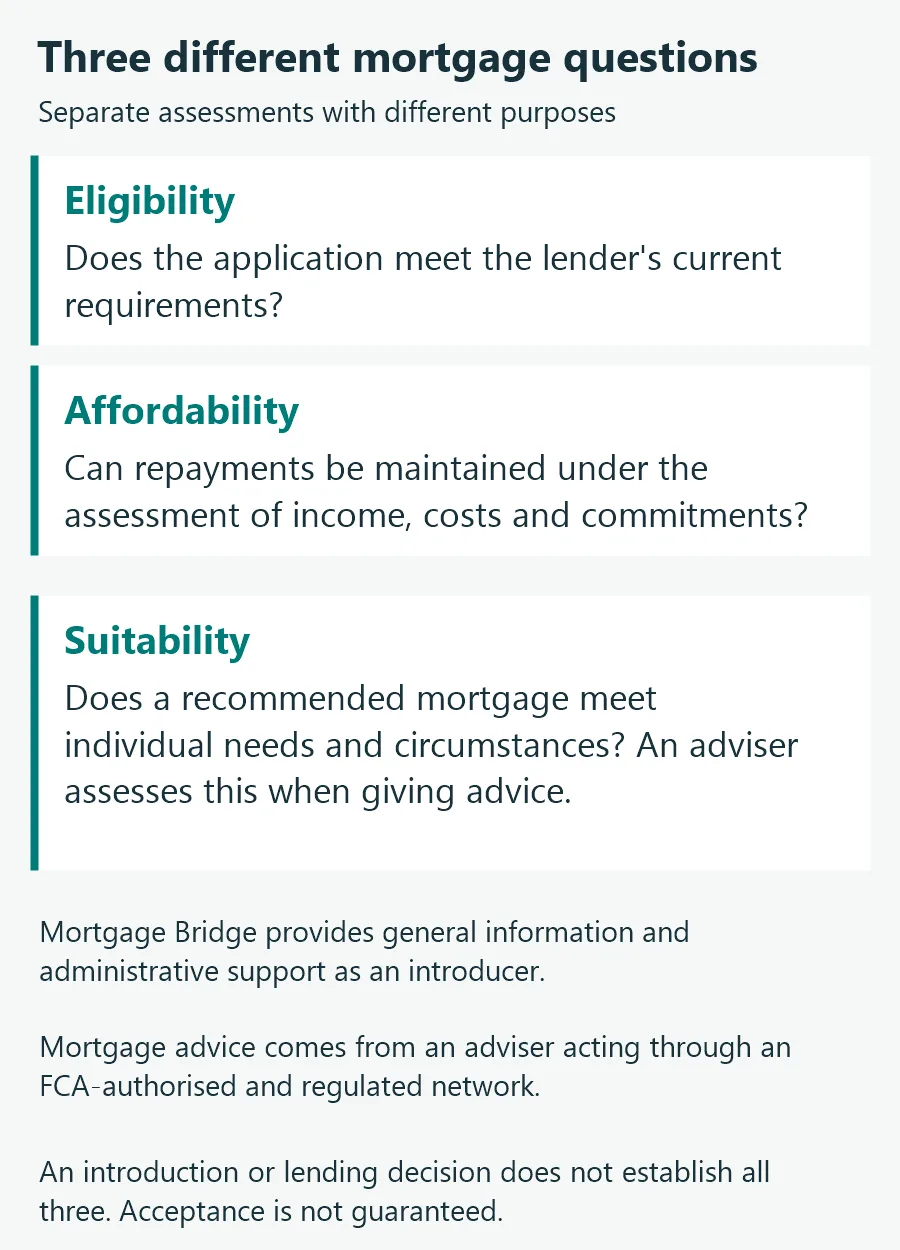
Eligibility means meeting a lender’s current requirements. Affordability concerns maintaining payments under the relevant assessment of income, costs and commitments. Suitability concerns whether a recommended mortgage meets an individual’s needs and circumstances; an adviser assesses this when giving advice. An initial check, valuation or lender approval does not establish all three.
The outcome depends on individual circumstances, supporting evidence, affordability, the property and lender criteria. Acceptance is not guaranteed.
Debt support and Mortgage Bridge’s role
Free, independent debt advice is available through MoneyHelper’s debt advice locator. This guide does not recommend changing debt repayments, taking new credit or using savings to obtain a mortgage.
Any review by Mortgage Bridge is administrative only. An introduction is not a lending decision or a personal recommendation. Mortgage Bridge has commercial relationships with receiving firms and receives a percentage of the adviser’s commission when an introduced case completes.
Read about us, our terms and conditions and our privacy policy.
Frequently asked questions
Does a previous mortgage establish current property acceptability?
No. The current property, reports and lender requirements need to be considered. A previous decision does not bind another assessment.
Is a lender’s valuation a full survey for the buyer?
No. A valuation serves the lender’s security assessment. A buyer’s survey and the conveyancer’s legal checks have different purposes.
Does meeting eligibility criteria establish affordability or suitability?
No. Eligibility concerns lender requirements; affordability concerns the ability to maintain payments; suitability concerns the individual needs assessed when an adviser makes a recommendation. These are separate questions.
Does Mortgage Bridge give personal mortgage or debt advice?
No. Mortgage Bridge provides general information and administrative support as an introducer. It does not assess eligibility, affordability or suitability or recommend products. Mortgage advice comes from an adviser acting through an FCA-authorised and regulated network.
Sources and review
- Halifax: mortgage criteria (one lender’s policy)
- Nationwide: property and construction criteria (one lender’s policy)
- GOV.UK: buying a home in England and Wales
- Financial Ombudsman Service: valuations and surveys
- MoneyHelper: buying and mortgage costs
- Nationwide: valuation policy (one lender’s requirements)
- MoneyHelper: applying for a mortgage
- Nationwide: affordability criteria (one lender’s policy)
- MoneyHelper: the mortgage advice service
- FCA: responsible lending and affordability
- FCA: advised mortgage sales and suitability
- MoneyHelper: secured debt and consolidation costs
Lender pages illustrate individual policies, not universal requirements or recommendations.
Last reviewed: . This article is subject to periodic review. Information, rules and lender criteria may change.
Check your credit in detail
View your full credit report
See your credit information from all three major credit reference agencies with Checkmyfile. Try it free, then it becomes a paid monthly subscription. You can cancel online anytime.
Check your credit report