


Mortgage Bridge provides general information and administrative support as a mortgage introducer. It does not provide mortgage or debt advice, assess eligibility, affordability or suitability, or recommend products. Mortgage advice comes from an adviser acting through an FCA-authorised and regulated network.
Your home may be repossessed if you do not keep up repayments on your mortgage.
Securing previously unsecured debts against a home increases the risk to the home. Lower monthly payments do not necessarily mean lower total costs. Longer repayment terms and fees can increase the total amount repaid.
A £10,000 deposit forms part of purchase funding rather than establishing a purchase budget or mortgage offer. The price less the actual advance determines the funding gap, and fees and other purchase costs may require separate money.
Purchase money raises questions about ownership, origin and availability as well as the amount held. A transfer can show money arriving without establishing the event that generated it or any conditions attached to its use.
This guide separates the lender’s deposit policy from the conveyancer’s legal and source-of-funds work. It does not recommend selling an asset, moving funds or using savings for a purchase, and it does not promise that a lawful source must be accepted.
Purchase funding: Deposit, price and loan-to-value
The purchase deposit is the part of the price not met by the mortgage advance. Loan-to-value compares borrowing with the value used by the lender, which may not equal the agreed price. Deposit size and the source of that deposit are separate questions. Neither a percentage nor a large cash balance establishes all lending requirements.
A lower valuation can increase the funding gap without changing what the seller wants to receive. Affordability can also restrict borrowing below a product’s maximum loan-to-value. Fees and purchase expenses may need additional funds. This guide therefore does not present a universal deposit range or suggest that a larger contribution automatically overrides income, credit, property or legal restrictions.
Evidence of where purchase money comes from
The lender and conveyancer can ask about savings, sale proceeds, inheritance, gifts and other sources. Their checks serve different responsibilities and one professional’s acceptance does not automatically satisfy the other. A balance at one date can show that money is present without explaining how it accumulated or who ultimately owns it.
Supporting records may need to trace a transfer back to its origin, including where another person is providing funds. Borrowed money and money subject to repayment or ownership conditions cannot simply be described as an unconditional gift. The SRA explains why identity and source-of-funds checks are required. Their scope depends on the transaction; there is no guaranteed exemption because the parties know one another.
How affordability differs from a headline income figure
Income establishes only part of a mortgage assessment. The lender also considers expenditure, existing financial commitments and relevant foreseeable changes under the rules that apply to the loan. Gross salary, take-home pay and the income a lender recognises are different figures. An online borrowing estimate cannot establish which amount will be accepted.
An income multiple can be a limit within a lender’s policy without being the amount it will offer. Property value, credit requirements and the requested term can impose separate restrictions. Two applicants earning the same amount can receive different decisions because their costs and circumstances differ. This guide does not set a universal salary threshold or promise a particular advance.
What income evidence can establish
Payslips, employment records, tax documents or business accounts can explain where earnings come from and how they are paid. The appropriate evidence depends on the source and the lender. Some information can be verified electronically; other applications require documents or clarification. There is no single document list or number of payslips that applies to every borrower.
Evidence of money received is not automatically evidence that it is recurring personal income. An account credit could be a transfer, reimbursement, loan or business receipt. A lender may need to distinguish these from earnings available for mortgage payments. A clear explanation can resolve a question about a record, but it does not oblige the lender to accept the income.
The deposit is only one part of buying costs
Purchase costs can include legal work, searches, surveys, valuation charges, mortgage fees, registration and any relevant property tax. Some costs arise before completion and may not be refundable if the purchase stops. The amount and timing depend on the transaction and the services used, rather than one standard allowance.
After completion there can be household bills, insurance, repairs and, for some properties, service charges or ground rent. A lender’s assessment and a buyer’s full ownership costs are related but not identical. A headline monthly mortgage payment does not show every outgoing. This article does not prescribe a savings target or recommend using money reserved for other commitments to meet a deposit.
A lender’s valuation is different from a buyer’s survey
A mortgage valuation addresses the property as security for the lender. It can use different methods and may not involve the level of inspection a buyer expects from a survey. A valuation does not certify that the building is free of defects, establish all repair costs or replace the conveyancer’s title checks.
The accepted value can differ from the agreed price or an estate agent’s estimate. Conditions, additional reports or legal information may affect the lender’s position. Paying for a valuation does not guarantee an offer. A buyer’s survey has its own scope, limitations and purpose; the appropriate service is a matter for the relevant professional rather than a mortgage approval outcome.
Need help with your mortgage?
What happens after a mortgage enquiry?
This is an initial enquiry for administrative support and an adviser introduction where appropriate. It is not a mortgage application or an eligibility assessment. Any mortgage advice comes separately from an adviser acting through an FCA-authorised and regulated network. The receiving firm explains its service, fees and information requirements.
Mortgage Bridge has commercial relationships with receiving firms and receives a percentage of the adviser’s commission when an introduced case completes. Acceptance is not guaranteed.
Ask about an adviser introduction
Send details of your enquiry for administrative support and an adviser introduction where appropriate. Mortgage Bridge does not provide mortgage or debt advice, assess eligibility, affordability or suitability, or recommend products. Mortgage advice comes from an adviser acting through an FCA-authorised and regulated network.
Make a mortgage enquiryNo obligation. Mortgage Bridge acts as a mortgage introducer.
Mortgage Bridge has commercial relationships with receiving firms and receives a percentage of the adviser’s commission when an introduced case completes.
Your home may be repossessed if you do not keep up repayments on your mortgage.
Mortgage fees and when they are payable
A mortgage can have a product or arrangement fee, valuation charges and other administration costs, depending on its terms. Adviser charges and legal costs may be separate. A zero-product-fee loan does not necessarily mean a cost-free application. Payment dates and refunds depend on the service or product and whether the transaction proceeds.
Where a fee is added to the mortgage, it becomes part of borrowing and can attract interest. Paying it upfront has a different cash requirement. Neither method is recommended here. The mortgage illustration and fee terms show the relevant amounts and assumptions; a comparison based only on the advertised rate can miss charges that materially affect the cost.
Eligibility, affordability and suitability
Visual explanation: eligibility, affordability and suitability
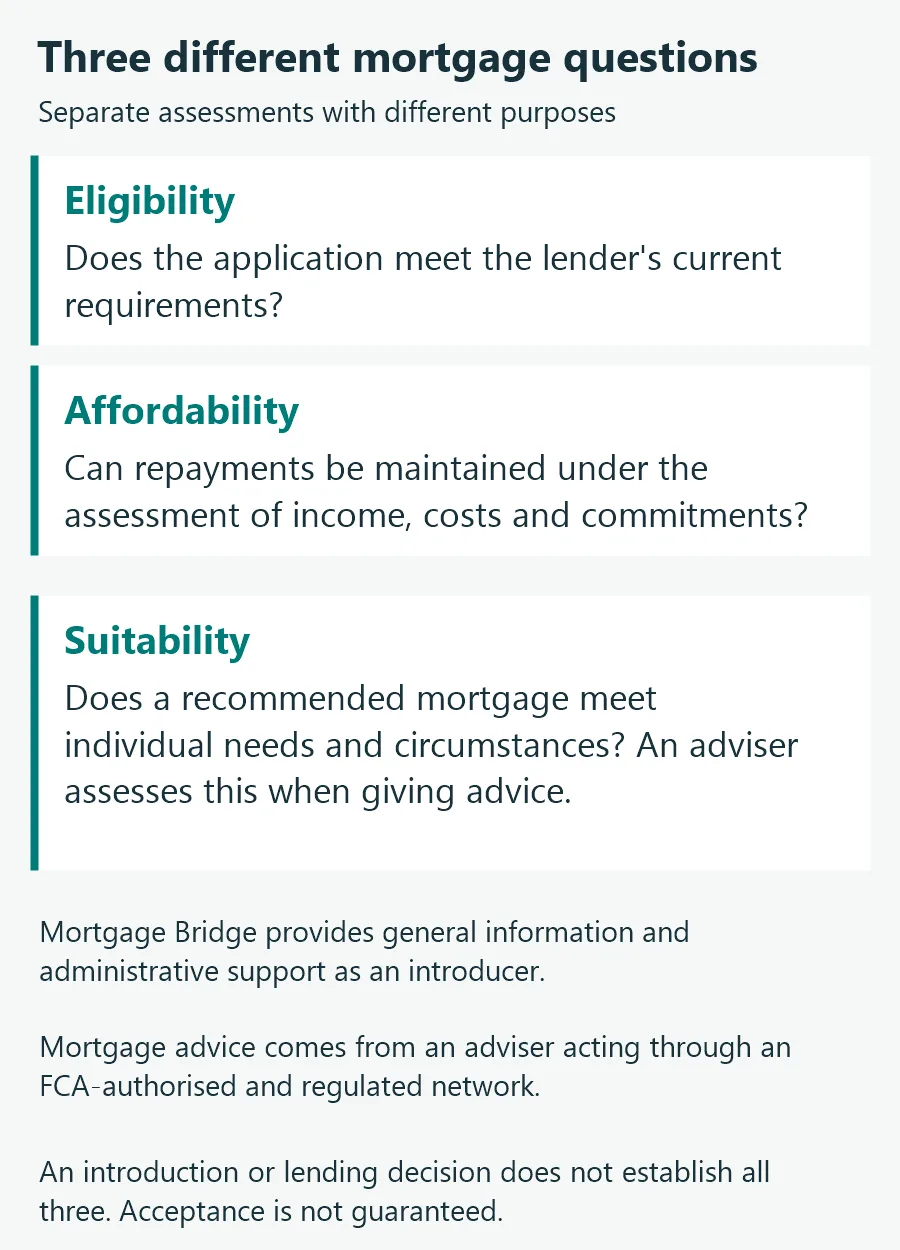
Eligibility means meeting a lender’s current requirements. Affordability concerns maintaining payments under the relevant assessment of income, costs and commitments. Suitability concerns whether a recommended mortgage meets an individual’s needs and circumstances; an adviser assesses this when giving advice. An initial check, valuation or lender approval does not establish all three.
The outcome depends on individual circumstances, supporting evidence, affordability, the property and lender criteria. Acceptance is not guaranteed.
Debt support and Mortgage Bridge’s role
Free, independent debt advice is available through MoneyHelper’s debt advice locator. This guide does not recommend changing debt repayments, taking new credit or using savings to obtain a mortgage.
Any review by Mortgage Bridge is administrative only. An introduction is not a lending decision or a personal recommendation. Mortgage Bridge has commercial relationships with receiving firms and receives a percentage of the adviser’s commission when an introduced case completes.
Read about us, our terms and conditions and our privacy policy.
Frequently asked questions
Does money in a bank account prove an acceptable deposit source?
No. Its origin, ownership and any conditions can require additional evidence. The lender and conveyancer have different responsibilities.
Does documenting a lawful source guarantee acceptance?
No. Evidence may explain the funds without satisfying every lender’s deposit policy or the other requirements of the application.
Does meeting eligibility criteria establish affordability or suitability?
No. Eligibility concerns lender requirements; affordability concerns the ability to maintain payments; suitability concerns the individual needs assessed when an adviser makes a recommendation. These are separate questions.
Does Mortgage Bridge give personal mortgage or debt advice?
No. Mortgage Bridge provides general information and administrative support as an introducer. It does not assess eligibility, affordability or suitability or recommend products. Mortgage advice comes from an adviser acting through an FCA-authorised and regulated network.
Sources and review
- MoneyHelper: applying for a mortgage
- Nationwide: affordability criteria (one lender’s policy)
- Halifax: mortgage criteria (one lender’s policy)
- SRA: identity and source-of-funds checks
- FCA: responsible lending and affordability
- Nationwide: employment income criteria (one lender’s policy)
- Nationwide: self-employed income evidence (one lender’s policy)
- MoneyHelper: buying and mortgage costs
- GOV.UK: buying a home in England and Wales
- GOV.UK: current and future leasehold reforms
- Nationwide: valuation policy (one lender’s requirements)
- MoneyHelper: the mortgage advice service
- FCA: advised mortgage sales and suitability
- MoneyHelper: secured debt and consolidation costs
Lender pages illustrate individual policies, not universal requirements or recommendations.
Last reviewed: . This article is subject to periodic review. Information, rules and lender criteria may change.
Check your credit in detail
View your full credit report
See your credit information from all three major credit reference agencies with Checkmyfile. Try it free, then it becomes a paid monthly subscription. You can cancel online anytime.
Check your credit report